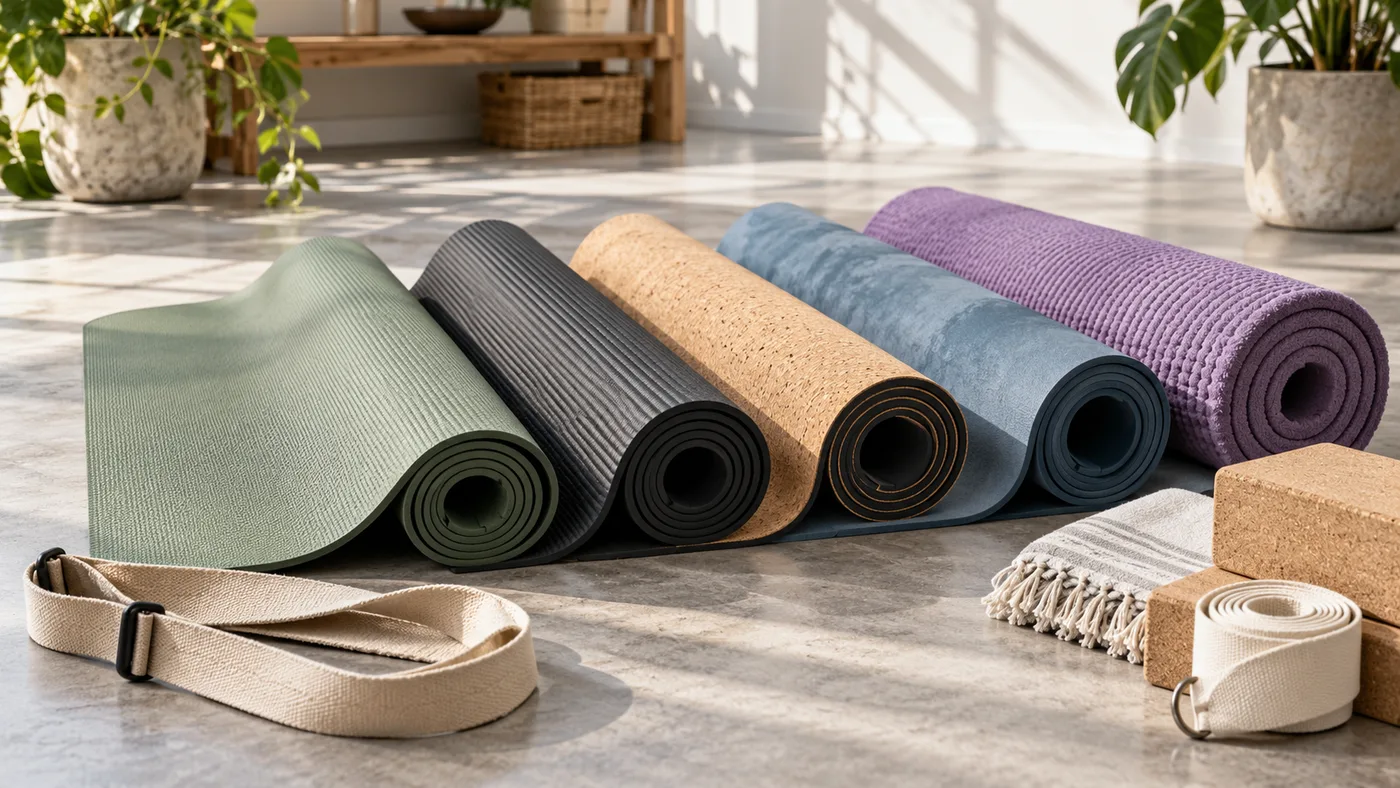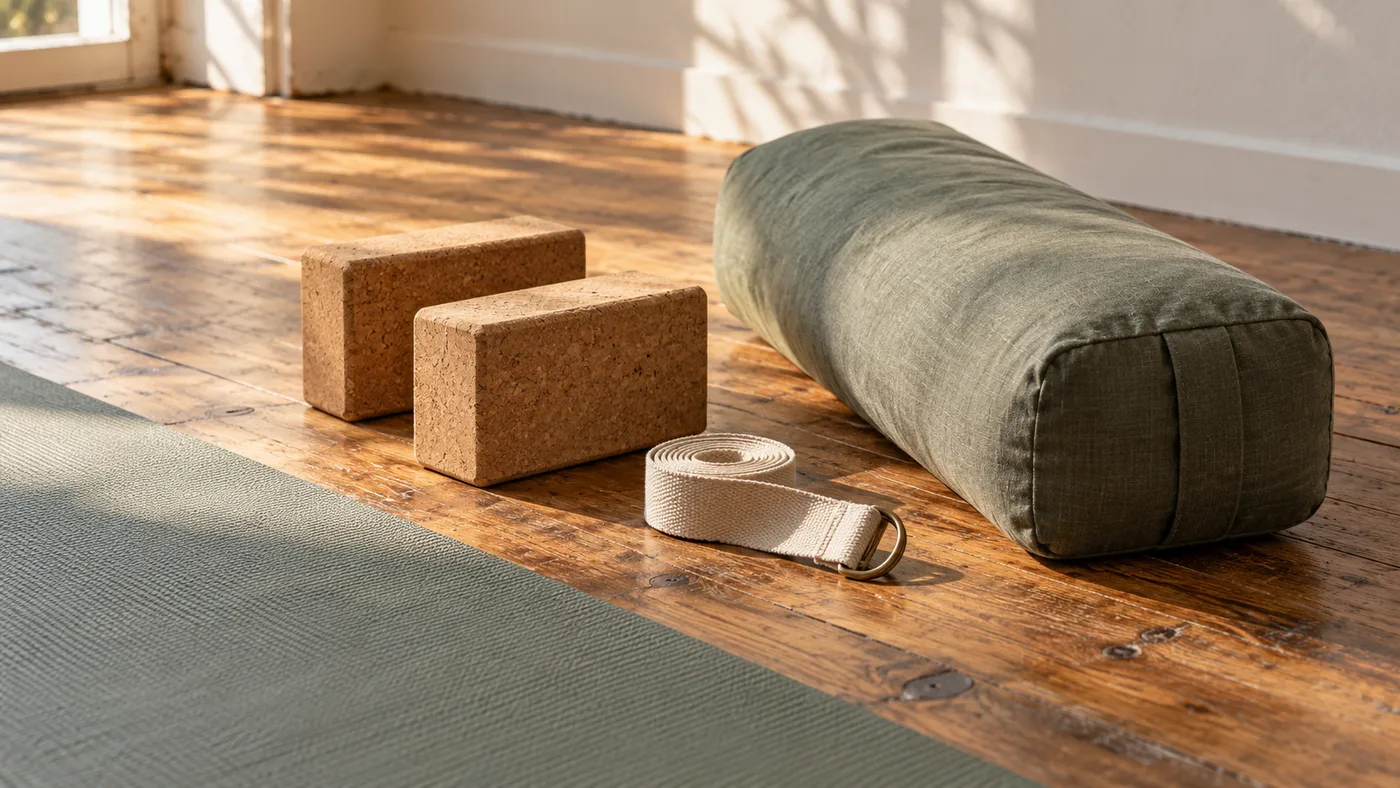
A yoga block changes the distance between you and the floor. A strap changes the distance between your hands and another body part. A bolster changes how much of your weight must be held without support. That functional difference matters more than color, brand, or whether a product is labeled “beginner” or “professional.”
You do not need all three to start yoga. Borrow props in class, notice the problem each one solves, and buy only the tool you will actually use. This guide helps you make that decision without treating props as corrective devices or promising that one product will fix pain.
About this guide: This is general equipment information, not an individual pose prescription. Learn specific prop placement with a qualified teacher who can adapt it to you.
The 30-Second Prop Map
| Prop | Primary job | Most useful when | Main buying priority | Common mistake |
|---|---|---|---|---|
| Block | Creates stable, adjustable height | The floor is too far away or you need a clear support surface | Stability at all three heights | Using the tallest setting when it wobbles |
| Strap | Extends reach and gives measurable feedback | Hands cannot comfortably reach a foot or each other | Non-stretch material and an easy-to-adjust buckle | Pulling harder instead of reducing range |
| Bolster | Supports a larger area and redistributes weight | A floor shape needs sustained, broad support | Firmness, dimensions, and a washable cover | Buying a soft decorative pillow that collapses |
The same prop can have other uses, but this map prevents random placement. First identify the job: height, reach, or broad support.
Yoga Blocks: Portable Height You Can Turn Three Ways
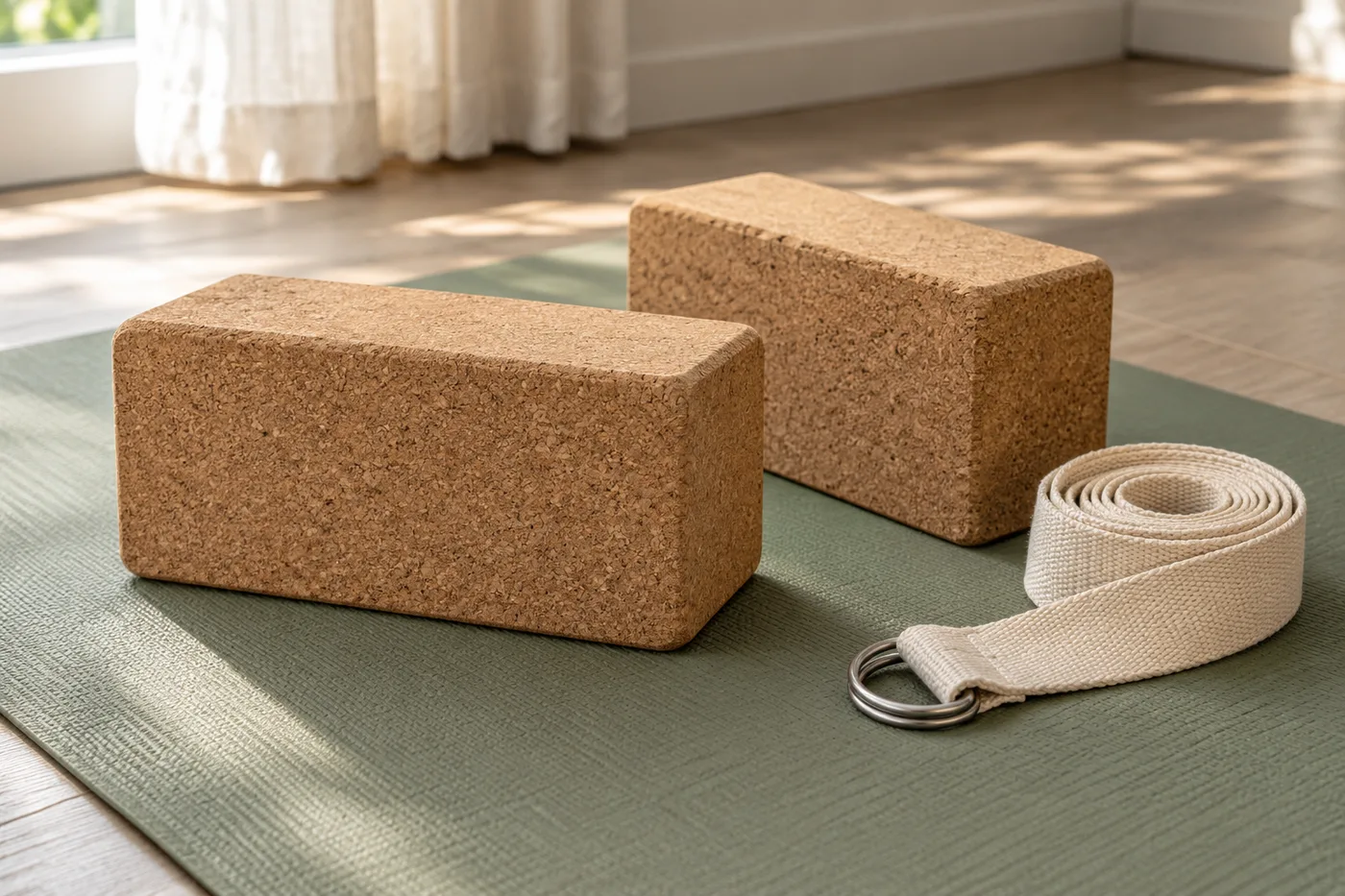
Most rectangular yoga blocks offer low, medium, and high orientations. Rotating the block changes both height and the size of the base touching the floor. The highest orientation provides the most lift but usually the smallest base, so it demands more balance and careful placement.
Yoga.org describes blocks as tools that can extend reach, provide support, and be used at three heights. Iyengar Yoga UK includes bricks and foam blocks among the props commonly used in class. The important point is not that a block “completes” a pose. It creates a surface at a usable distance.
Three practical jobs for a block
1. Bring the floor closer. In a standing position where hands are intended to contact the floor, a block can provide an intermediate surface. That may allow the student to keep attention on the rest of the instruction rather than collapsing toward an unreachable target.
2. Raise a seat. Sitting on a stable low height can change the relationship between the pelvis and legs. The appropriate height and shape depend on the person and activity; a block edge may be too hard for prolonged sitting, so a folded blanket or meditation cushion can be more comfortable.
3. Provide spatial feedback. A teacher may ask a student to lightly touch, hold, or press a block to understand distance or direction. This is not the same as squeezing as hard as possible. The purpose should be explained.
Foam, cork, or wood?
| Material | Typical feel | Advantages | Trade-offs | Good fit for |
|---|---|---|---|---|
| Foam | Light, slightly forgiving | Easy to carry; softer against the body; often lower cost | Can dent; lightweight versions may feel less steady | General home use, transport, sensitive contact points |
| Cork | Firm, textured, heavier | Stable feel; good grip when dry; resists compression | Heavier; edges may feel firm; cork quality varies | Students who prioritize a solid base |
| Wood | Very firm and durable | Precise surface; little compression | Hard, heavy, and less forgiving; often expensive | Students whose classes specifically use rigid blocks |
Material alone does not determine quality. Test whether the block sits flat on every side, resists twisting, and has edges your hands can tolerate.
One block or two?
One block can solve a single support problem, but a pair allows symmetrical setups and can be easier when both hands need the same height. Before buying two, check the classes or videos you actually use. Two matching blocks are generally more predictable than mixing heights, densities, or dimensions.
Block safety check
Place the block on a firm, non-slip surface. Press it from several directions before putting meaningful weight through it. Do not stack blocks unless a qualified teacher has shown a stable setup for that exact use. If the block rocks, compresses dramatically, cracks, or slides, change the setup rather than adapting your body to unstable equipment.
Yoga Straps: Extra Reach Without Extra Momentum
A yoga strap is usually a long, non-stretch woven belt with a buckle or loop. Its simplest function is to connect your hands to a point they cannot comfortably reach while allowing you to keep some distance.
Three practical jobs for a strap
1. Extend your reach. Holding the strap instead of forcing a hand-to-foot connection can make the position more accessible.
2. Keep a repeatable hand distance. A strap can provide a consistent width for certain arm movements. That makes it easier to notice whether you are changing the distance to force range.
3. Create a loop or boundary. In method-specific teaching, a loop may help organize the relationship between body parts or props. Looped applications require instruction; never place a strap where tightening, slipping, or pressure could be hazardous.
What to look for
- Length: Enough for the movements and body proportions involved, with room to hold both ends securely. Do not assume the shortest retail option is universal.
- Material: A firm, low-stretch weave gives clearer feedback than an elastic exercise band. Resistance bands are a different tool.
- Buckle: It should adjust deliberately and release without a struggle. D-ring and cinch buckles feel different; try both if possible.
- Width and edge feel: A strap that twists into a narrow edge can become uncomfortable in the hands or against the body.
- Wash instructions: Check the manufacturer's care label before cleaning; some straps require hand washing and air drying.
The biggest strap error: turning reach into leverage
A strap can tempt the user to pull a limb farther because the hands now have leverage. That defeats the purpose. The strap should help establish a manageable connection, not overpower resistance or pain. Keep the grip light enough that you can reduce tension immediately.
Never loop a strap around the neck, use it to suspend body weight, or imitate wall-rope systems without purpose-built equipment and qualified instruction. A retail yoga strap is not climbing or suspension gear.
Yoga Bolsters: Broad, Firm Support for Sustained Positions
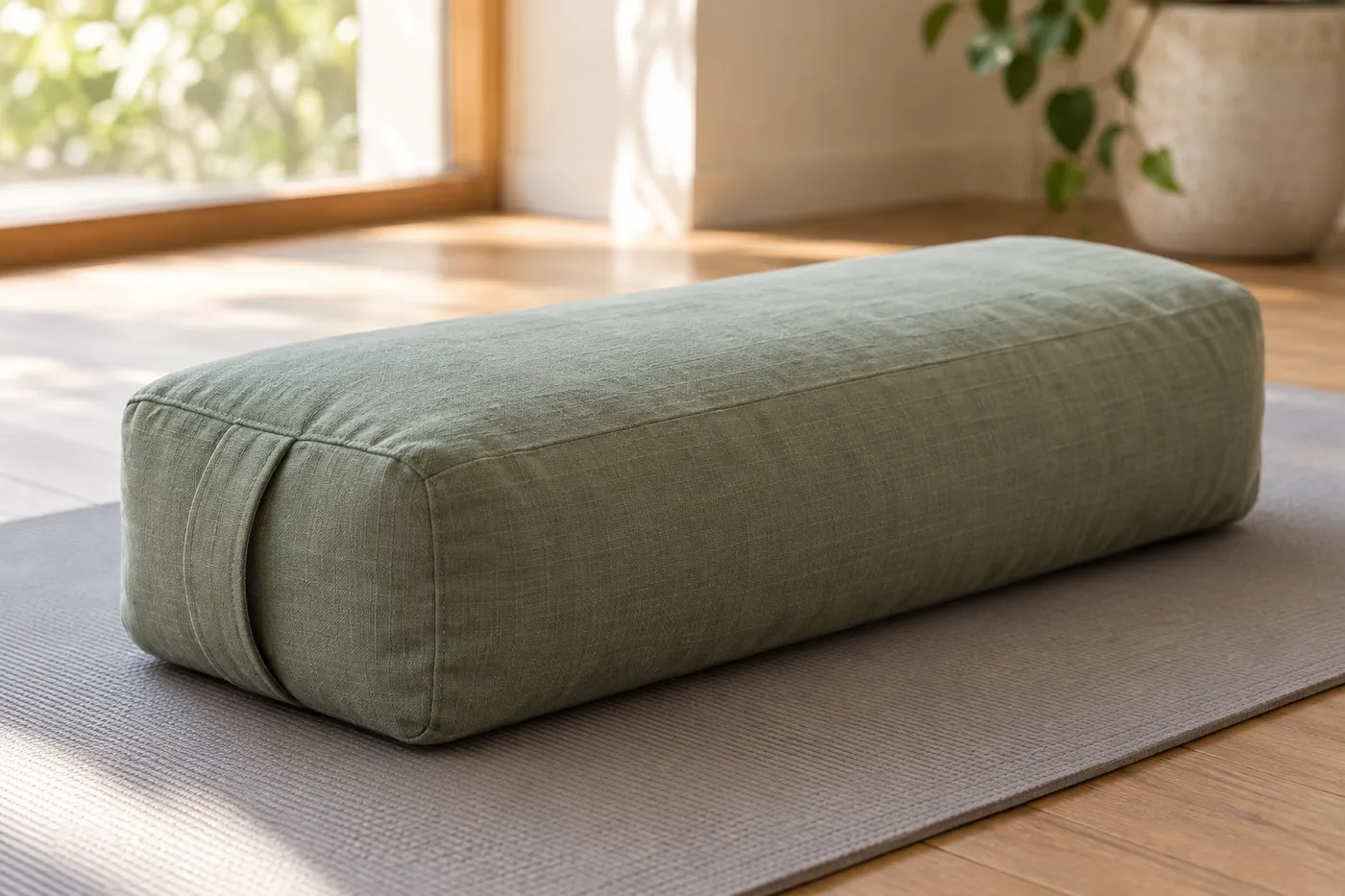
A bolster is a densely filled cushion designed to support more surface area than a block. Unlike a bed pillow, a useful yoga bolster resists collapsing immediately under body weight.
Bolsters appear in several types of classes, including Iyengar, restorative, prenatal, and Yin settings, but the intention and placement differ. The presence of a bolster does not make a practice automatically restorative or appropriate for a health condition.
Three practical jobs for a bolster
1. Reduce the distance to a resting surface. A bolster may support the trunk, legs, or another large area so the student is not holding the full gap.
2. Distribute contact over a wider area. Compared with a block, a bolster creates a broader and softer support surface.
3. Make a position sustainable for the intended duration. In a quiet class, support may reduce unnecessary work. “Sustainable” does not mean tolerating numbness, sharp pain, or restricted breathing.
Rectangular or round?
Rectangular bolsters offer flatter surfaces and are less likely to roll. They can be predictable under the length of the torso or legs.
Round bolsters provide a curved support surface. Compare the shape and dimensions with the bolster your teacher uses rather than assuming it will work like a rectangular one.
Neither shape is universally better. Choose based on the classes you follow and the placement your teacher actually uses.
What to inspect before buying
- dimensions, rather than the word standard;
- firmness under your body weight;
- total weight if you will carry it to class;
- a removable, washable outer cover;
- handles attached securely enough for carrying;
- fill material and any allergy or care considerations;
- whether refill or replacement covers are available.
If shopping online, compare exact measurements with a cushion you already own. Product photos often hide scale.
Which Prop Should a Beginner Buy First?
Use this decision tree:
Buy two blocks first when:
- your classes frequently use blocks under one or both hands;
- a teacher has shown you stable block options you repeat at home;
- you want a compact prop that serves several categories of posture;
- you need adjustable height more often than broad cushioning.
Buy a strap first when:
- a teacher regularly gives you a strap variation;
- reach is the recurring obstacle, not floor height;
- you travel and want a light, packable prop;
- you know the required length and buckle style.
Buy a bolster first when:
- your chosen class format requires one for most sessions;
- firm household cushions do not reproduce the support your teacher uses;
- you have tested the shape and firmness in class;
- storage and cleaning are realistic in your home.
Buy nothing yet when:
- you have not taken a class that uses props;
- a studio supplies clean equipment;
- you are guessing based on social-media photos;
- you expect a prop to diagnose or cure pain;
- you have nowhere stable to practice or store it.
For many beginners, a matched pair of stable foam or cork blocks is the most versatile first purchase—but that is a practical default, not a universal prescription.
Can Household Items Substitute?
Sometimes, for gentle reach extension or low-load cushioning. A non-stretch robe tie may extend reach, while a firm folded blanket or dense sofa cushion may add cushioning in a teacher-approved setup. These examples do not make household items reliable substitutes for balance support or substantial weight-bearing.
Substitution becomes risky when the object slides, collapses, opens, has sharp corners, or is being asked to bear substantial weight. A stack of loose books is not equivalent to a purpose-made block; a belt buckle can dig into the body; a pillow may flatten without warning.
Use this four-part check:
- Stable: Does it stay in place when pressed from the direction of use?
- Strong: Can it tolerate the expected load without collapsing or opening?
- Appropriate: Does its shape create the support the teacher intended?
- Releasable: Can you leave the position and remove the prop easily?
If any answer is uncertain, do not use the substitute for that setup.
Match the Prop to the Problem
Imagine three common situations:
“My hand does not reach the floor.”
Start by asking whether the hand needs to reach the floor at all. If a supported surface is part of the teacher's alternative, a block may solve the height problem. A strap would not create a stable surface.
“My hands do not meet, and I am straining to connect them.”
A strap may bridge the reach, provided the teacher has shown the setup. A block is unlikely to solve a hand-to-hand distance problem.
“I can enter the floor position, but I cannot remain without holding myself up.”
A bolster may provide broad support, or the position may simply be inappropriate that day. The prop should not be used to trap the body in a shape.
This function-first reasoning is more transferable than memorizing dozens of prop photos.
Care and Replacement
Follow the manufacturer's instructions because foam, cork, wood, fabric, buckles, and fill respond differently to moisture and cleaning agents.
- Wipe shared blocks before and after use according to studio policy.
- Let props dry completely before enclosed storage.
- Follow the strap's care label; some require hand washing only and hanging to dry. Do not assume a strap is machine washable.
- Wash removable bolster covers separately when the label allows.
- Inspect seams, handles, buckles, cracks, dents, odor, and loss of firmness.
Replace a prop when damage changes its stability or when it can no longer perform its intended job. Cosmetic wear alone may not matter; structural uncertainty does.
Frequently Asked Questions
Are cork blocks better than foam blocks?
Not universally. Cork is often heavier and firmer; foam is often lighter and more forgiving. Stability, comfort, transport, and the exact use determine the better choice.
Do I need a special strap if I own a resistance band?
Usually, yes, if the instruction calls for a non-stretch yoga strap. Elastic resistance changes the feedback and should not be substituted automatically.
Can I use a pillow instead of a bolster?
For some low-load cushioning, perhaps. A soft pillow may collapse and is not a reliable substitute when a firm, predictable height is essential.
Why does my teacher use blocks even with advanced students?
Props can clarify direction, provide feedback, create a specific relationship, or support longer study. They are not a rank system.
Can props prevent injury?
No prop guarantees safety. Appropriate instruction, stable equipment, a suitable class level, and the ability to stop all matter. NCCIH notes that injuries can occur in yoga and advises qualified instruction, especially for beginners and people who may require modifications.
Sources
| Source | Author or organization | Published/updated | Specific information used |
|---|---|---|---|
| What Are Props and How Do I Use Them? | Yoga.org; no individual byline shown | No publication/update date shown; accessed October 21, 2026 | General functions of blocks, straps, and bolsters; three block heights; the advice to adjust or stop using a prop if it makes a pose feel worse. |
| Starting Iyengar Yoga: Frequently Asked Questions | Iyengar Yoga (UK) | No publication/update date shown; accessed October 21, 2026 | Use of bricks, foam blocks, blankets, belts, and bolsters in a methodical class; asking a teacher what equipment is required. |
| Align Yoga Strap: Use & Care | Manduka | No publication/update date shown; accessed October 21, 2026 | This strap's instructions specify hand washing only and hanging to dry; an example of why care must follow the individual product label. |
| Yoga: Effectiveness and Safety | National Center for Complementary and Integrative Health, U.S. National Institutes of Health | Last updated August 2023 | Yoga injury context, qualified instruction, beginner cautions, and individual modification discussions for pregnancy, older adults, injuries, and health conditions. |