Iyengar and Yin classes can both move slowly and use plenty of props, yet they ask very different things of a student. An Iyengar class commonly uses detailed instruction, deliberate sequencing, and active work to study how a posture is organized. A Yin class commonly uses mostly floor-based shapes held for longer periods, giving the student time to observe and adjust sensation.
Neither description guarantees what will happen at your local studio. The experience varies with the teacher, student level, and the session's focus. Use this comparison to ask better questions about a class, its teacher, and whether it fits your current needs.
About this guide: This comparison offers general information for choosing a class, not individual medical advice. Class structure varies by teacher, level and setting; ask the teacher about suitable starting points and adaptations.
The Short Answer
Choose an introductory Iyengar class if you want explicit setup, active alignment work, methodical progression, and frequent use of equipment to investigate a pose. Choose a beginner Yin class if you want fewer postures, more time in each shape, mostly seated or reclining work, and a quieter environment for noticing sensation.
That is a preference filter, not a quality ranking. The better class is the one whose teacher, level, room, and teaching method match what you can use safely and consistently.
Side-by-Side: What You Are Likely to Notice
| Question | Iyengar class | Yin class |
|---|---|---|
| What drives the class? | Detailed actions, alignment, sequencing, and progressive learning | Time in a shape, graduated sensation, stillness, and observation |
| Where does practice happen? | Standing, seated, reclining, and other categories depending on level | Often primarily seated or reclining floor shapes |
| What do the muscles do? | Many postures involve deliberate, active muscular work | The teacher may invite less voluntary muscular effort in the target area, depending on the pose |
| How long is one shape explored? | Long enough to receive and apply detailed instructions; timing varies | Commonly longer holds; exact duration varies by teacher, student, and pose |
| How are props used? | To make actions observable, support alignment, adapt range, and build progressively | To adjust intensity, support a sustainable position, or reduce unnecessary effort |
| What might feel challenging? | Coordinating multiple precise actions and maintaining active attention | Staying still, regulating intensity, and resisting the urge to chase a deeper range |
| What might the room sound like? | Regular verbal instruction and corrections | More silence between shorter periods of guidance |
| Is it restorative yoga? | It can be; Iyengar practice includes restorative and recuperative sequences. Check whether the specific class focuses on them. | Yin and restorative yoga are distinct approaches, even when their supported shapes look similar. |
These are tendencies, not rules. A gentle Iyengar class can include quiet supported work. A Yin teacher may speak extensively about anatomy, philosophy, or sensation. Ask about the actual class rather than selecting by name alone.
What an Iyengar Class May Feel Like
The B.K.S. Iyengar Yoga Association of Northern California describes Iyengar Yoga as a system of hatha yoga developed by B.K.S. Iyengar, with attention to alignment, balance, strength, stamina, flexibility, concentration, and awareness. Iyengar Yoga UK describes its teaching as methodical and progressive, emphasizing detailed correctness and safety.
For a student, those principles often appear as a cycle:
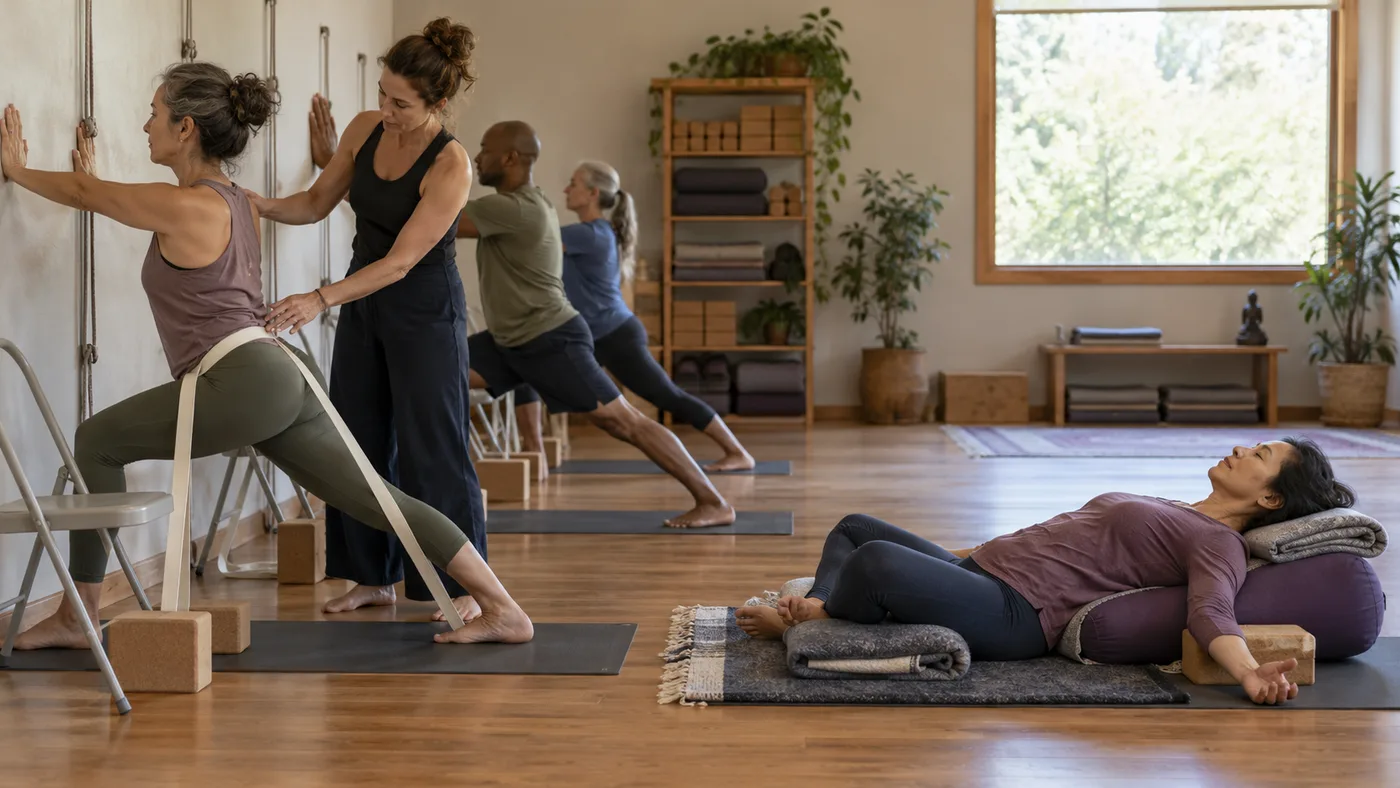
- The teacher names and demonstrates a posture.
- The class enters the posture and applies a small number of actions.
- Students come out, observe, and listen to the next instruction.
- The posture may be repeated so the new action can be tested.
You may spend more time learning how to place the feet, distribute weight, use the arms, or organize a support than moving through a continuous flow. The intellectual demand can be as noticeable as the physical work. This suits people who enjoy concrete language and iterative learning; it may frustrate someone seeking uninterrupted movement.
Props are not an admission of failure
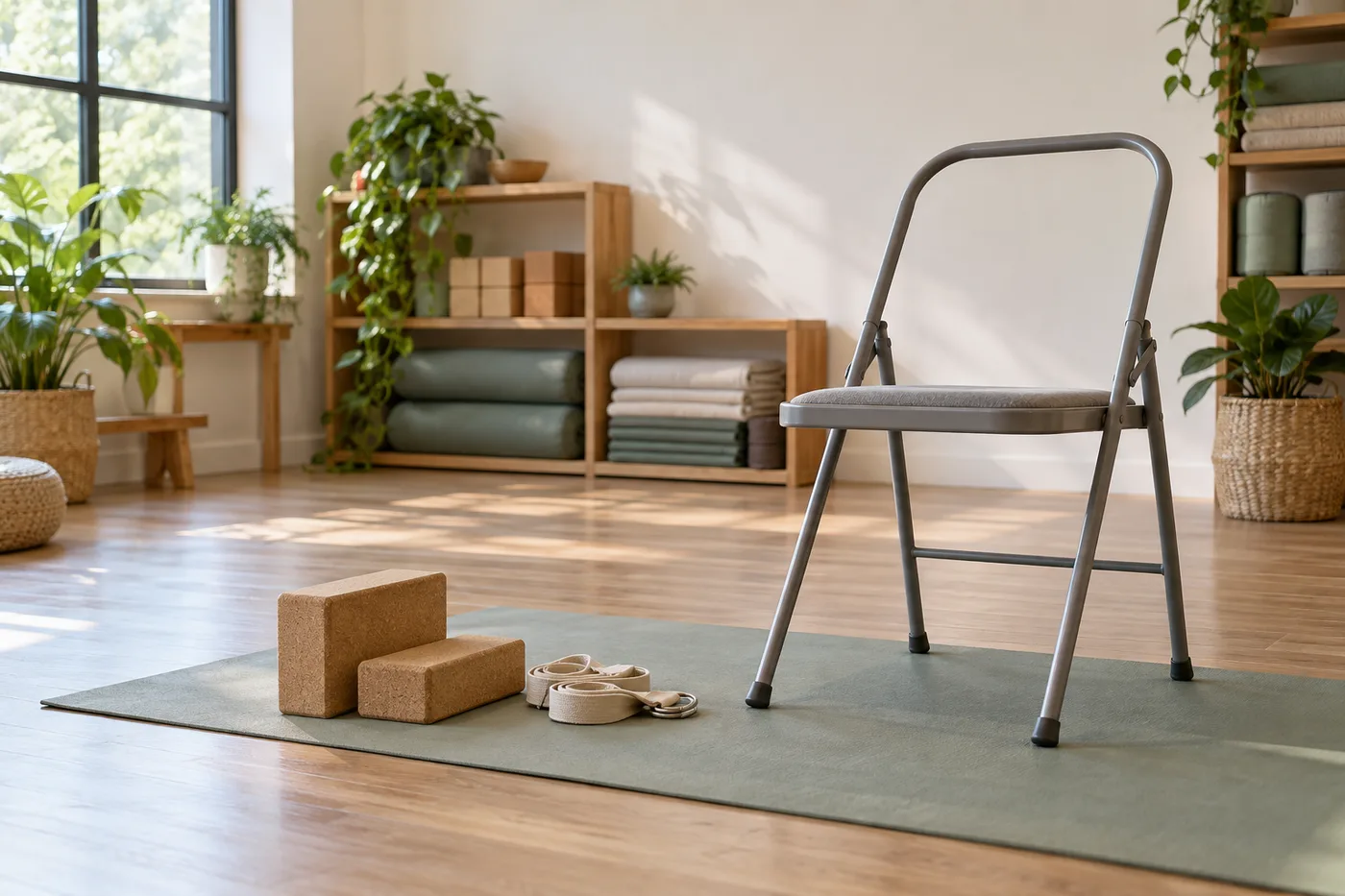
Blocks, belts, blankets, bolsters, chairs, and walls can make a direction clearer or adapt the relationship between the person and the posture. Iyengar Yoga UK says props may allow students to progress at their own pace and according to their body. The prop is part of the teaching method, not a badge assigned only to beginners.
For example, a teacher might use a block to bring the floor within reach while asking the student to maintain a specific action through the legs and trunk. That is different from using a block merely to make the pose easier. The exact setup should come from a qualified teacher; equipment placement can change the effect of the posture.
The likely learning curve
At first, detailed instructions can arrive faster than you can process them. That is normal. Try to apply one or two key actions instead of attempting to perfect every body part at once. A progressive beginner series is often more useful than sampling isolated classes because the vocabulary and prop setups build over time.
What a Yin Class May Feel Like
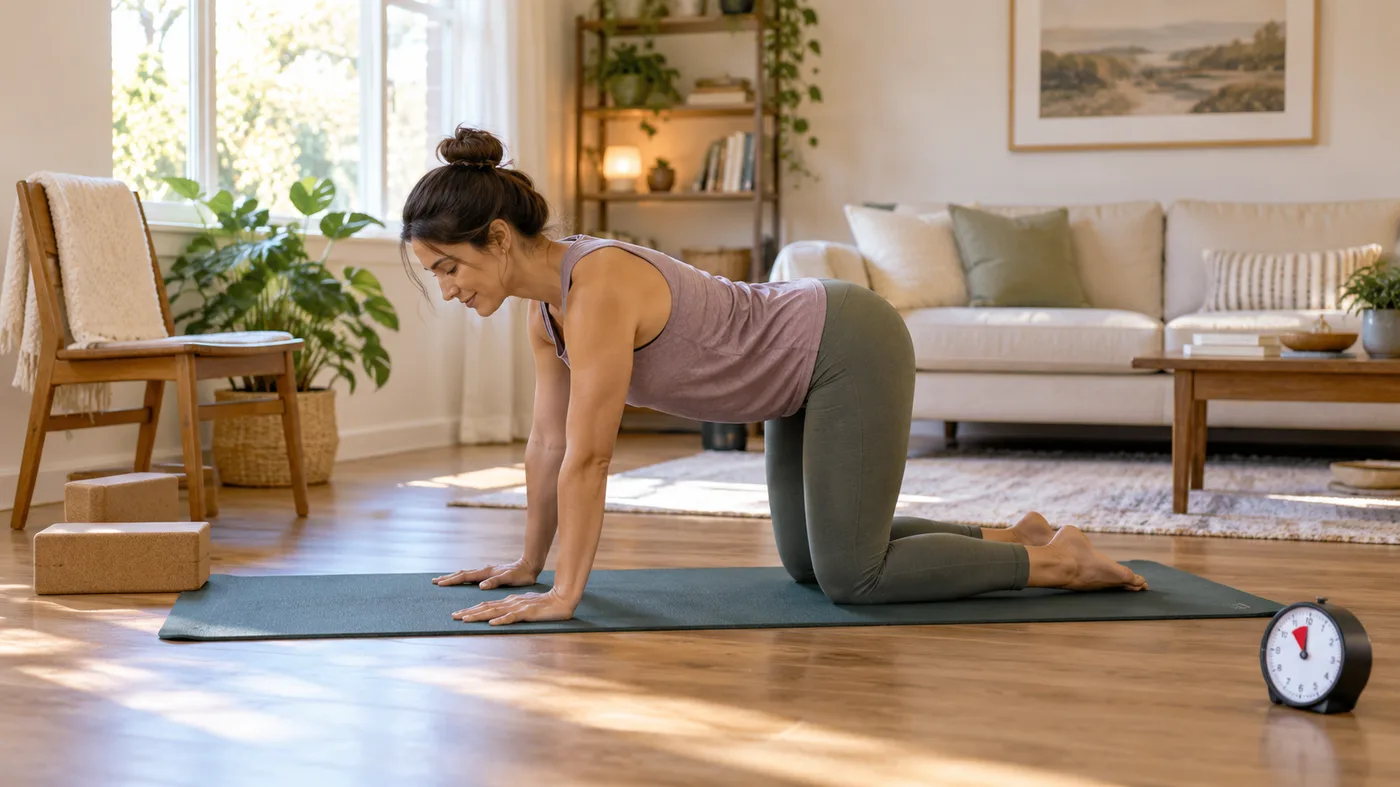
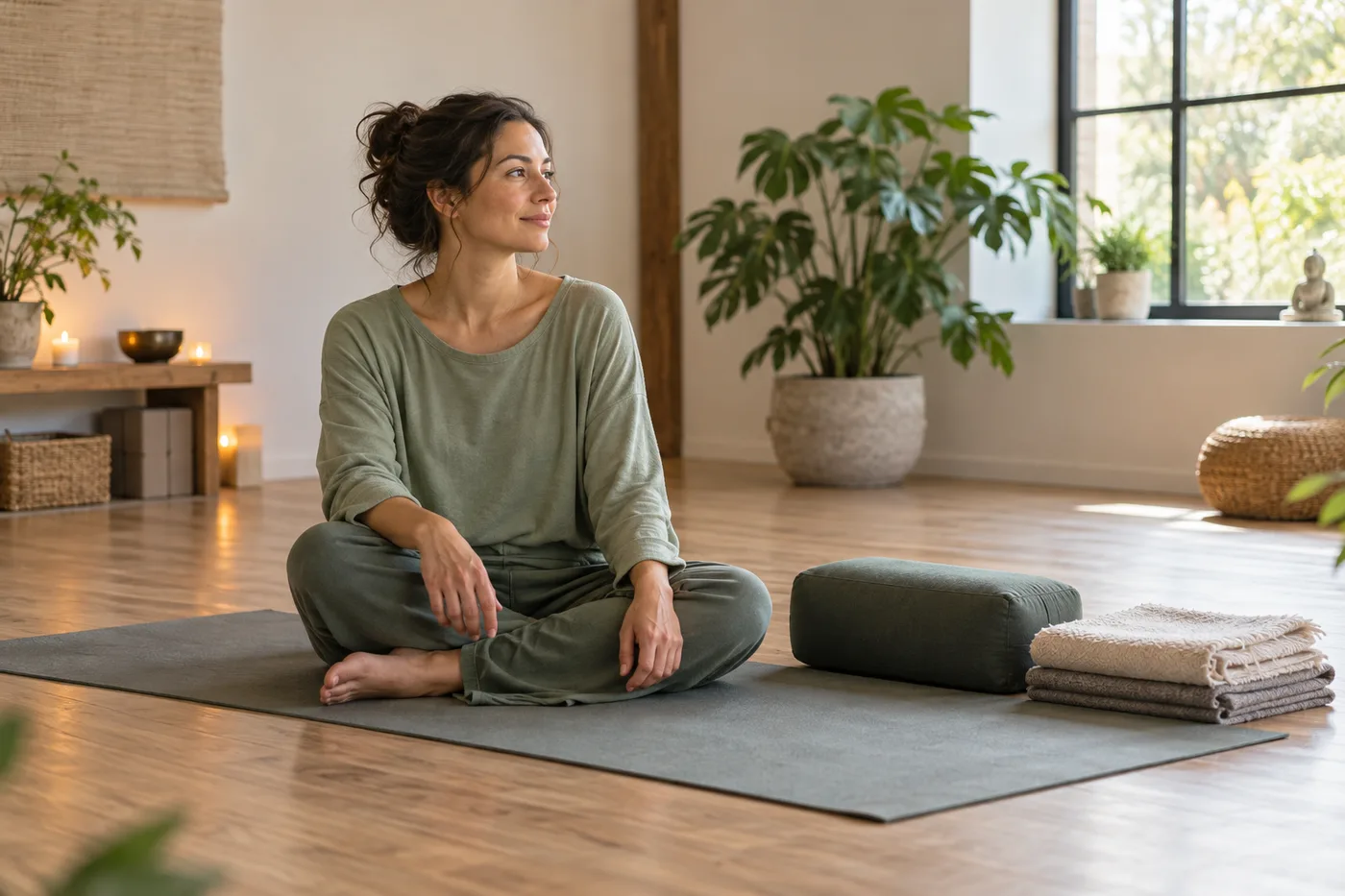
In Bernie Clark's YinSights material, Yin Yoga is described as distinct from more dynamic, muscular styles and as challenging partly because postures are held longer. The source also explicitly says Yin Yoga is not restorative yoga.
A typical beginner experience may look like this:
- The teacher introduces a mostly floor-based shape and names the broad area or experience being explored.
- You arrange props and enter a range that feels sustainable, not maximal.
- External movement reduces while you continue monitoring sensation and breath.
- You leave the shape gradually and may pause in a neutral position before the next side or posture.
Longer does not mean “better,” and stillness does not mean immobility at all costs. You can change the angle, add support, shorten the hold, or come out. A responsible teacher should explain what kinds of sensation are acceptable within that class and make stopping ordinary rather than dramatic.
Why quiet can be demanding
In an active class, the next movement quickly replaces the previous one. In Yin, time gives you more opportunity to notice impatience, uneven sensation, uncertainty, or the desire to force progress. The practical skill is not tolerating the most intense position. It is choosing a level of sensation that remains manageable and reassessing it as time passes.
Bernie Clark's overview uses very broad possible hold times, but that range should not be copied into a beginner plan without context. Your local teacher's timing, the shape, and your situation matter more than a number on a page.
Yin is not automatically gentle or therapeutic
The room may be quiet and the postures may be close to the floor, yet sustained positions can feel intense. Yin is not a generic solution for pain, injury, stress, or limited mobility. If tissue is injured, Clark advises allowing it to heal before returning to regular practice. Questions about an injury or condition belong with an appropriately licensed healthcare professional, followed by a teacher who can stay within their own scope.
Same Prop, Different Job
The visual overlap between the two methods can be misleading. A bolster, block, or belt may appear in both rooms, but the teaching question may differ.
In an Iyengar class
The teacher might ask: Does this support help you understand a direction, distribute effort, or maintain the intended organization of the posture?
In a Yin class
The teacher might ask: Does this support help you regulate intensity and remain in a sustainable version of the shape without unnecessary effort?
In both cases, prop height and placement matter. A support that helps one person may be unstable or excessive for another. See the site's blocks, straps, and bolsters guide for the function of each object, then learn posture-specific placement from a qualified teacher.
Choose by Learning Preference, Not Stereotype
Iyengar may be worth trying when you prefer:
- precise verbal instruction;
- visible demonstrations and repeated attempts;
- a progressive curriculum;
- active standing work as well as floor work;
- a teacher who explains how and why a prop is being used;
- feedback on the organization of a posture.
Yin may be worth trying when you prefer:
- fewer postures per class;
- longer periods to observe one position;
- mostly seated and reclining shapes;
- quiet between instructions;
- autonomy to regulate range and duration;
- a practice that does not depend on keeping pace with a moving sequence.
Try both when:
- you like precise active study on some days and quieter observation on others;
- you are still learning what teaching language helps you;
- class schedule, teacher quality, and accessibility matter more than labels;
- you want direct experience before committing to a series.
The methods do not cancel each other out. They also do not need to be combined in the same session to be useful.
Five Questions to Ask a Studio Before Booking
- Is this class suitable for someone completely new to this method? “All levels” is not the same as “introductory.”
- How is the class typically structured? Ask about standing versus floor work, average number of postures, and whether demonstrations are included.
- What props are required and supplied? A home Yin class may assume you own a bolster; an Iyengar class may supply a larger equipment set.
- What training does the teacher have in this specific method? A general yoga credential does not show method-specific depth.
- How are pain, modifications, and hands-on adjustments handled? Look for explicit opt-out language and clear consent.
For Iyengar classes, verify the instructor's current Certified Iyengar Yoga Teacher status through the relevant national Iyengar association. Iyengar certification follows standards set by RIMYI in Pune, with internationally recognized levels. For any class, credentials are one data point rather than proof of personal fit. Observe how the teacher communicates, responds to questions, and stays within professional scope.
Four Situations to Help You Choose
Scenario A: You want to understand why a standing pose feels unstable
An introductory Iyengar class may be the more direct experiment. The teacher is likely to slow the setup, use the wall or blocks if useful, and ask you to repeat the posture with a specific change. You can compare the two attempts.
Scenario B: You dislike fast transitions and want time to locate a workable range
A beginner Yin class may fit better. You are likely to enter fewer shapes and have time to add a prop or reduce the angle. The right class should let you leave early without framing intensity as achievement.
Scenario C: You have an acute injury or unexplained pain
Neither generic group class is the first decision-maker. Seek appropriate clinical assessment. Then ask a teacher with relevant competence whether a class is suitable; do not rely on a style label as treatment.
Scenario D: You become anxious when instructions are dense
Yin may offer more processing time, but silence and long holds are not comfortable for everyone. A slower, small-group Iyengar fundamentals class may be easier because instructions are concrete and the teacher can answer questions. Sample both.
Frequently Asked Questions
Is Iyengar Yoga harder than Yin Yoga?
“Harder” hides the useful difference. Iyengar may demand more active coordination, strength, and response to detailed cues. Yin may demand patience, intensity regulation, and comfort with longer stillness. Either can be made inappropriate by the wrong level or poor teaching.
Is Yin just stretching?
That description is incomplete. Yin classes include attention, time, breath, stillness, and a particular approach to physical sensation. Avoid translating every Yin cue into a medical claim about fascia or joints; ask the teacher what is evidence, tradition, or personal teaching language.
Is Iyengar Yoga only for people with injuries?
No. The method is a complete approach to yoga practice, not simply rehabilitation. Although props can adapt positions, a group class is not a substitute for diagnosis or individualized clinical care.
Will I sweat?
Possibly in either class, depending on room temperature, sequence, effort, and individual response. Sweat is not a reliable measure of class quality.
Which is better for beginners?
Both can welcome beginners when the class is specifically designed for them. Teacher clarity, appropriate level, consent, and options matter more than the style name.
Can I practice both in the same week?
Many people do, but frequency and recovery are individual. Begin conservatively, note how each class affects you, and avoid using one method to force range for the other.
A Better Decision Than “Which One Wins?”
Book one introductory class in each method, ideally with teachers whose specific training you can verify. After each class, score five things from 1 to 5: clarity, ability to opt out, manageable sensation, quality of teacher response, and desire to return. The higher total is not a verdict on the tradition—it is evidence about your present fit.
If neither works, the answer may be a different teacher, a smaller class, a chair-based format, a slower general beginner course, or non-yoga movement. The goal is not to choose the most impressive label. It is to find a learning environment you can use.
Sources
| Source | Author or organization | Published/updated | Specific information used |
|---|---|---|---|
| What Is Iyengar Yoga? | B.K.S. Iyengar Yoga Association of Northern California | No publication/update date shown; accessed October 21, 2026 | Iyengar Yoga's method, origins, and emphasis on alignment, balance, strength, stamina, flexibility, concentration, and awareness. |
| Starting Iyengar Yoga: Frequently Asked Questions | Iyengar Yoga (UK) | No publication/update date shown; accessed October 21, 2026 | Methodical progressive teaching, detailed correctness and safety, graded beginner learning, and the use of blocks, blankets, belts, and bolsters. |
| Restorative Class | Iyengar Yoga (UK), teacher class listing | No publication/update date shown; accessed October 21, 2026 | An example of a dedicated restorative class within Iyengar teaching, using sequences associated with B.K.S. and Geeta Iyengar. |
| Iyengar Yoga Certification | Iyengar Yoga National Association of the United States | No publication/update date shown; accessed October 21, 2026 | RIMYI's role in setting certification standards, internationally recognized certification levels, and verification of current Certified Iyengar Yoga Teacher status. |
| What Is Yin Yoga? | Bernie Clark, YinSights on YinYoga.com | No page-level publication/update date shown; site copyright 2006–2026; accessed October 21, 2026 | Yin as distinct from dynamic muscular styles, longer-held postures, the fact that Yin can be challenging, and the distinction between Yin and restorative yoga. |