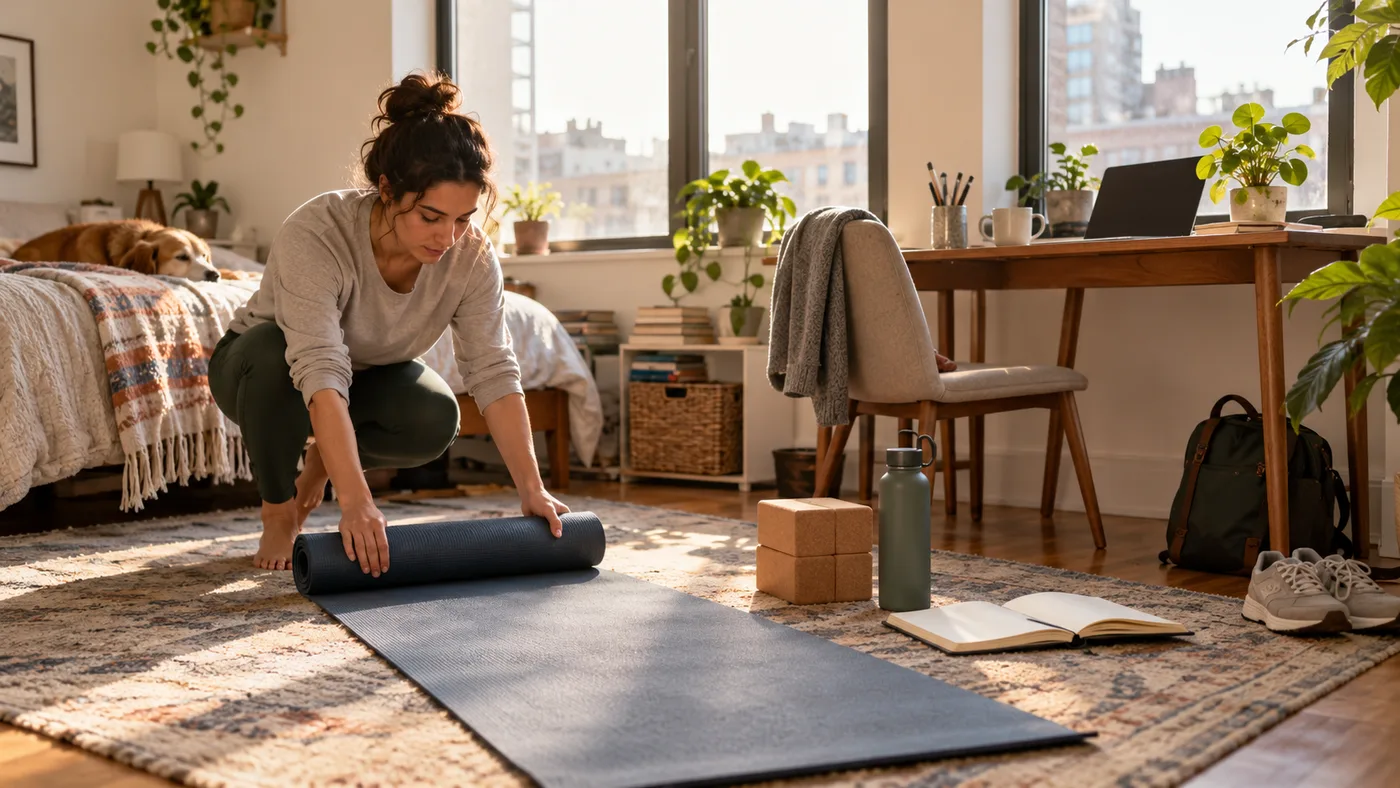
Your first yoga class does not require an expensive outfit, advanced flexibility, or knowledge of Sanskrit pose names. It requires a class that welcomes beginners, clothes that let you move without distraction, and enough information to make decisions about your own body.
This guide takes you from booking to the trip home. The short version is simple: contact the studio, choose a true beginner class, arrive early, tell the teacher what they need to know, and treat every instruction as an option rather than a test.
About this guide: General information for choosing and attending a beginner class. Adapt class choices, clothing and equipment to your circumstances; this guide does not replace individual instruction or medical advice.
The 10-Minute Decision Before You Book
Class names are not standardized. “Open level” may mean genuinely accessible, or it may assume that students already know common transitions. “Gentle” describes intensity, not necessarily the amount of explanation. “Flow” often involves moving between poses, while a beginner fundamentals class is more likely to stop and explain them.
Read the class description, then ask the studio three direct questions:
- Is this class designed for someone who has never practiced yoga?
- Will the teacher demonstrate basic setup and offer alternatives?
- What equipment is supplied, and what must I bring?
If the answer to the first question is vague, look for a class labeled beginner, fundamentals, introduction, or level 1. A short introductory series can be easier than entering a different mixed-level class every week because the teacher can build skills in sequence.
Choose the environment as carefully as the style
A class can be technically beginner-friendly and still be a poor fit. Check:
- room temperature, especially whether the class is heated;
- class length and whether students may leave early;
- stairs, parking, changing rooms, and accessibility;
- class size and whether the teacher can see everyone;
- the studio's late-arrival and cancellation policies;
- whether hands-on adjustments are used and how consent is requested;
- fragrance, phone, footwear, and mat-cleaning rules.
Yoga Alliance states that physical adjustments require explicit, informed consent and that silence is not consent. You are allowed to decline touch before class or at any point during it. A studio may use consent cards or tokens, but you can also tell the teacher plainly: “No hands-on adjustments for me today.”
What to Wear: Use the Fold-and-Reach Test
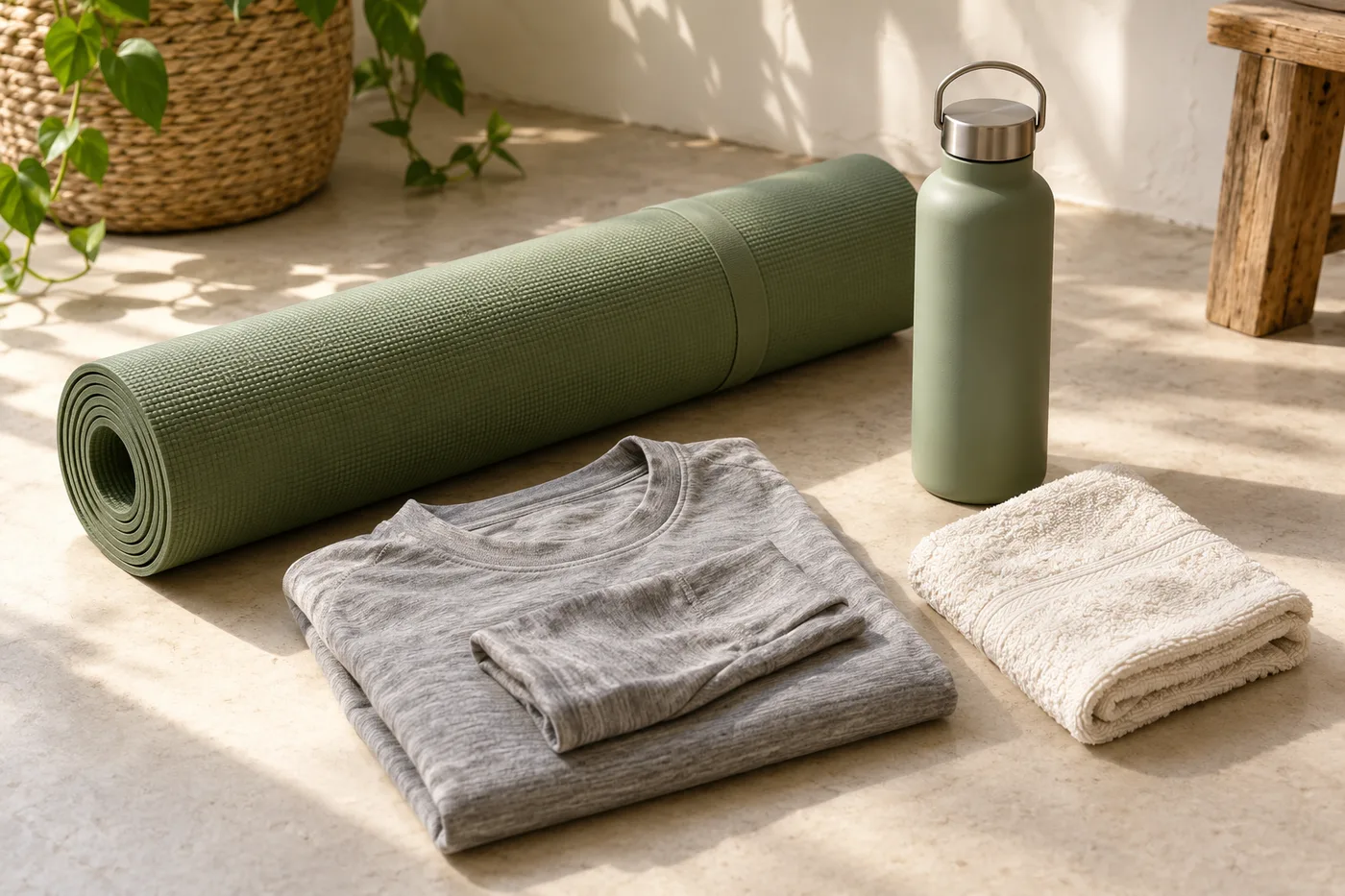
You do not need yoga-specific clothing. Choose clean, comfortable clothes that stay in place when you bend, reach overhead, kneel, and lie down. Iyengar Yoga UK notes that many students wear a T-shirt with leggings or shorts and practice barefoot.
Before leaving home, do two movements in front of a mirror:
- Reach both arms overhead. Check that your top does not restrict your shoulders or expose more than you want.
- Hinge forward with bent knees. Check that the waistband remains comfortable and the top does not fall over your face.
The useful clothing qualities are:
- Range of motion: You can step wide and bend your knees without pulling at seams.
- Predictability: The garment stays where you put it.
- Breathability: The fabric and layers suit the room temperature.
- Low distraction: Zippers, belts, jewelry, and hard fasteners do not press into you on the floor.
- Personal coverage: You feel comfortable in standing, folded, seated, and lying positions.
Fitted does not have to mean tight. A closer-fitting top is simply easier to manage in forward folds and positions where the hips may be higher than the head. If you prefer loose clothing, tuck the hem securely or add a fitted layer underneath.
Feet, socks, hair, and glasses
Most studio classes are practiced barefoot because bare feet can grip the mat. Follow the studio's policy. If you need socks, ask whether grippy yoga socks are appropriate; ordinary socks can slide on some floors.
Tie long hair in a style that remains comfortable when the back of your head rests on the floor. Remove dangling jewelry. Glasses are usually fine, though you may want a secure case nearby for positions in which they shift.
What to Bring—and What to Leave at Home
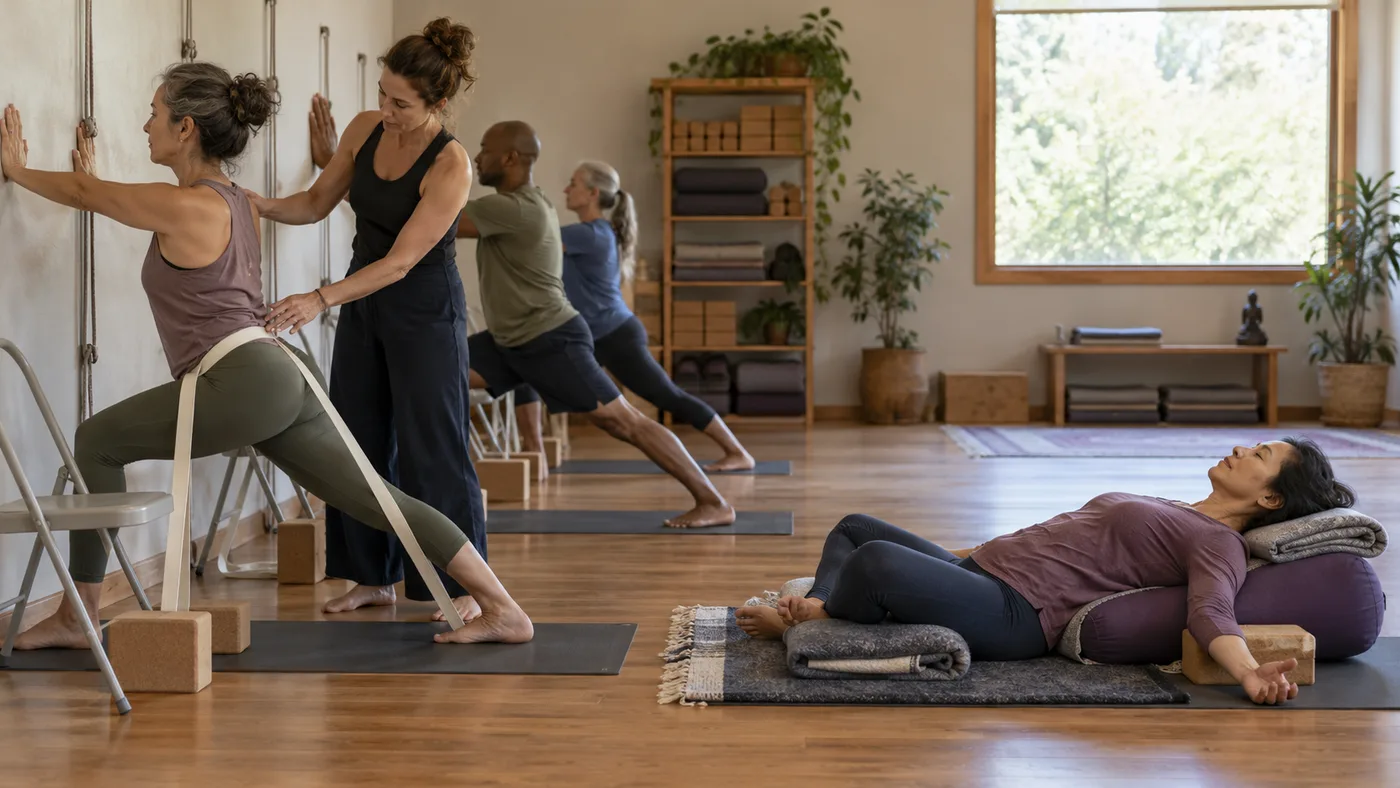
Confirm the studio's equipment list before buying anything. Iyengar Yoga UK advises new students to ask the teacher what is provided; its classes may use mats, blocks, blankets, belts, and bricks. Other studios may supply everything, charge for mat rental, or require personal mats.
A sensible first-class bag
- booking confirmation and any required identification;
- a yoga mat only if the studio does not provide one;
- water in a secure, quiet bottle;
- one light layer for arrival and final rest;
- hair tie and a small towel if useful;
- necessary medication you normally carry;
- a mat towel only if the studio or class conditions call for one.
Leave perfume, glass bottles, noisy accessories, and a large meal immediately before class at home. Silence your phone completely, including alarms and watch notifications. Keep valuables to a minimum and ask where bags are stored.
Do not buy a full prop collection for one class. Borrow or rent first, notice what the teacher actually uses, then read the practical guide to blocks, straps, and bolsters before choosing equipment.
The Questions Worth Asking Before Class
You do not need to disclose your entire health history to a receptionist. You do need enough information to decide whether a general group class is appropriate.
Ask the studio
- Is the class truly suitable for a first-time student?
- Is the room heated, and to approximately what temperature?
- Are mats and props included, rented, or sold?
- How early should a new student arrive?
- Does the teacher use hands-on adjustments? How is consent handled?
- Can students rest or skip a pose without leaving the room?
- Is there a teacher with relevant experience for my circumstances?
Tell or ask the teacher privately
- “This is my first yoga class. Where can I set up so I can see you?”
- “I prefer verbal instruction and no hands-on adjustments.”
- “What resting position should I use if I need a break?”
- “Are there any transitions beginners commonly miss in this class?”
If you are pregnant, older, recovering from injury or surgery, or managing a health condition, contact an appropriate healthcare professional and the instructor before relying on a generic class. The U.S. National Center for Complementary and Integrative Health (NCCIH) advises these groups to discuss individual needs because some practices may need modification. A yoga teacher should not diagnose an injury or replace licensed medical care; Yoga Alliance's scope of practice says teachers must remain within their actual credentials and refer out when advice falls outside them.
Your First-Class Timeline
15–20 minutes before: arrive and orient yourself
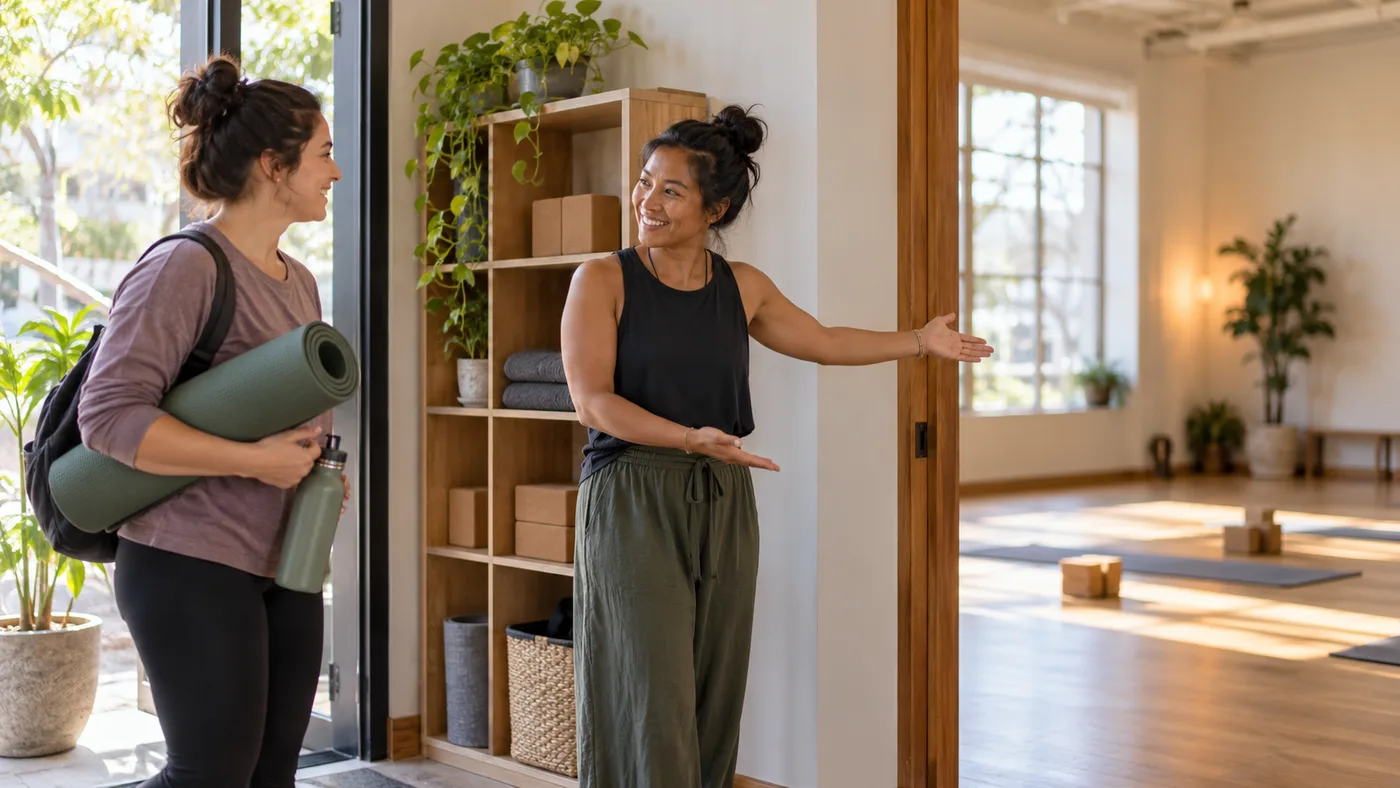
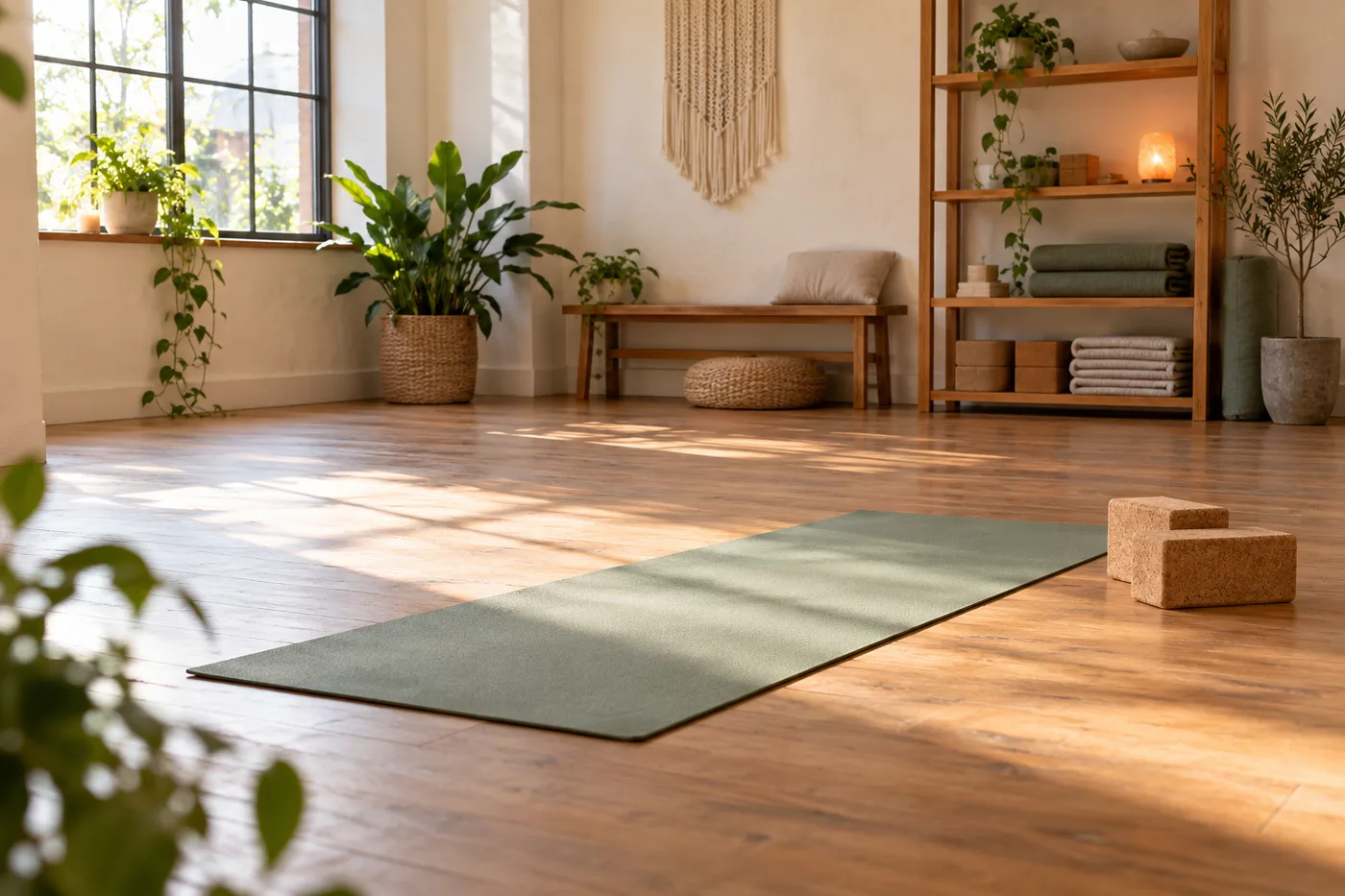
Check in, locate the changing area and restroom, and ask where shoes and bags belong. Tell the teacher you are new before the class begins, not while everyone is already moving. Choose a place with a clear view rather than automatically hiding at the back.
Set out only what you need. Put blocks and a strap within reach if the class uses them. Sit, lie down, or wait quietly according to the studio culture; you do not need to warm yourself up with poses you have never learned.
During class: listen for the purpose, not a perfect shape
A teacher may use English names, Sanskrit names, or both. Watch the demonstration and listen for action words. If you lose track, pause and look; there is no need to rush into a shape to catch up.
Choose a manageable range and keep your breathing comfortable and unforced. If a movement becomes painful, unstable, or difficult to follow, stop and ask the teacher for an alternative. Do not push through pain. A teacher can help explain or adapt an exercise, but cannot diagnose the cause of a symptom without appropriate healthcare qualifications.
Recognize possible medical emergencies. The American Heart Association advises calling 911 in the United States for heart attack or stroke warning signs. These can include chest pain or pressure, shortness of breath, sudden one-sided weakness, facial drooping, or difficulty speaking. If these warning signs occur, stop exercising and call for emergency help immediately; outside the United States, use the local emergency number. Do not wait until class ends or assume that symptoms which ease have become harmless.
NCCIH advises beginners to avoid extreme practices such as headstands, shoulder stands, lotus position, and forceful breathing. A good beginner class should provide a normal, pressure-free way to opt out.
The resting option is part of the class
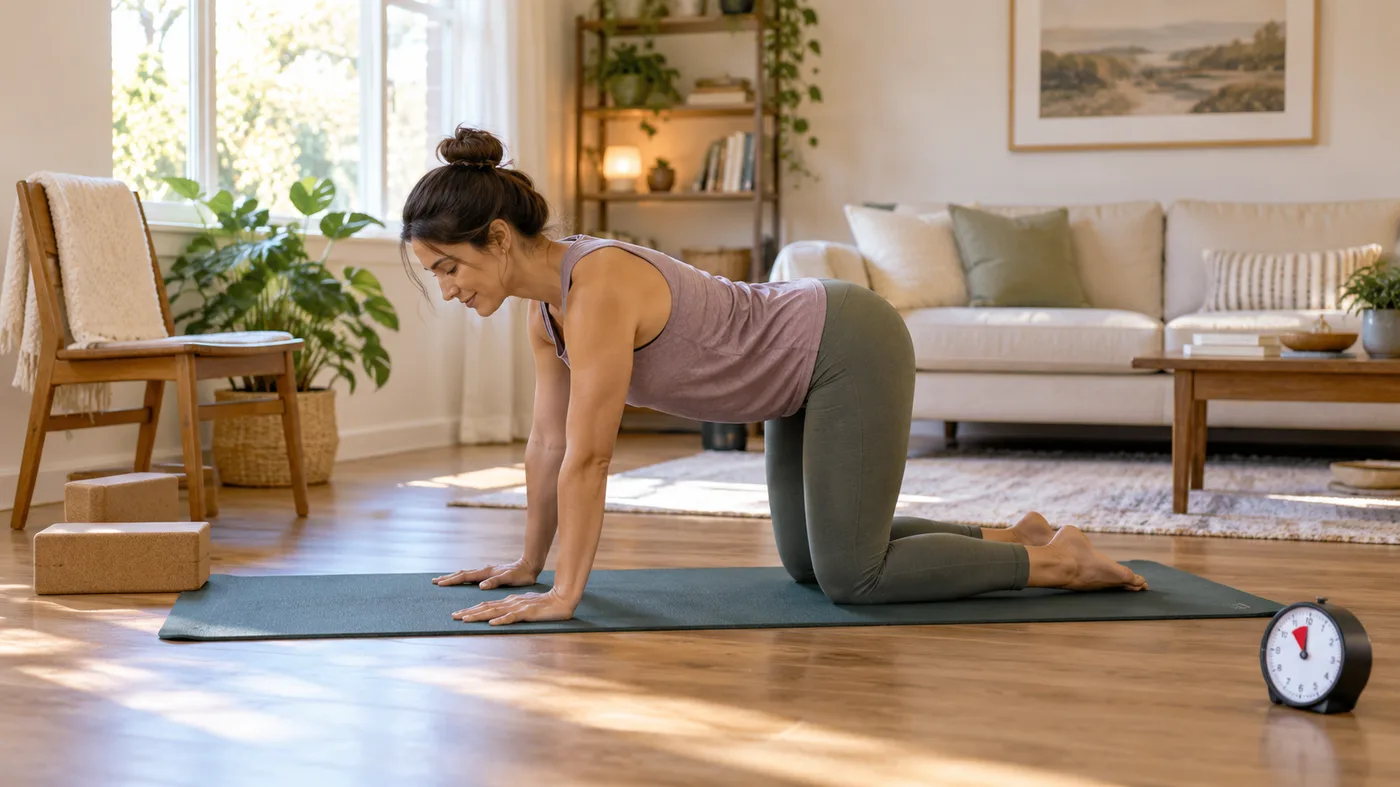
Teachers may suggest Child's Pose, lying on your back, sitting, or standing quietly. No single resting position suits everybody. Ask for one that is comfortable and easy to enter and exit. Resting is not falling behind; it is a skill that keeps the practice responsive.
After class: leave slowly and take notes
Sit up gradually after the final rest, especially if you have been lying down. Return borrowed equipment as instructed and wipe the mat if required. If a cue confused you, ask one concise question after class rather than trying to solve it by copying another student.
Within a few hours, note:
- one part of the class you understood;
- one part that felt unclear;
- any discomfort that persisted after leaving a pose;
- whether the pace and teaching style suited you;
- what you would ask before returning.
These observations are more useful than whether you touched your toes.
What a Good First Class Should Feel Like
The class does not have to be easy, but it should be navigable. You should know when an exercise begins and ends, how to make it smaller, and how to rest. The teacher should make room for questions without presenting every student's body as a problem to fix.
Consider trying a second class when the first was unfamiliar but respectful. Choose a different teacher or format when instructions were consistently unclear, opting out was discouraged, touch occurred without consent, pain was praised as progress, or the teacher made medical promises beyond their qualifications.
Frequently Asked Questions
Do I have to be flexible before starting yoga?
No. Flexibility is not an entry requirement. A beginner class should teach usable positions and options for the body you have today.
Should I eat before class?
Avoid arriving uncomfortably full, but do not use a generic rule to override your medical or nutritional needs. If timing food is important for a health condition, follow guidance from your healthcare professional.
Can I keep my shoes on?
Most studios ask students to leave shoes outside the practice area, but accessibility and health needs vary. Ask the studio rather than assuming.
What if I cannot follow the teacher?
Pause, watch, and rejoin at a stable position. After class, ask whether a slower fundamentals class or introductory series would be more suitable.
Is soreness normal?
New activity can feel unfamiliar, but this article cannot evaluate symptoms. Pain that is sharp, severe, worsening, associated with swelling or neurological symptoms, or otherwise concerning deserves appropriate professional assessment.
Do I have to allow the teacher to adjust me?
No. Hands-on adjustment requires consent. You can decline without explanation and can change your mind during class.
The One-Screen Checklist
Before booking: beginner level, temperature, accessibility, equipment, teacher, consent policy.
Wear: tested, movable clothes; appropriate layers; minimal hard accessories.
Bring: only confirmed essentials, water, and necessary personal items.
Arrive: 15–20 minutes early and introduce yourself.
During: breathe normally, choose options, rest, decline touch if desired.
After: note fit, not performance; ask one useful question; decide whether to return.
Sources
| Source | Author or organization | Published/updated | Specific information used |
|---|---|---|---|
| Starting Iyengar Yoga: Frequently Asked Questions | Iyengar Yoga (UK) | No publication/update date shown; accessed October 21, 2026 | Typical class clothing, barefoot practice, asking the teacher about equipment, and examples of commonly supplied props. |
| Yoga: Effectiveness and Safety | National Center for Complementary and Integrative Health, U.S. National Institutes of Health | Last updated August 2023 | Qualified instruction, beginner practices to avoid, injury risk, and the need for individual discussion for pregnancy, older adults, injuries, and health conditions. |
| Scope of Practice | Yoga Alliance | Last updated February 27, 2020 | Explicit informed consent for physical adjustments, accurate sourcing, online/group teaching, and the requirement to teach and advise within one's credentials. |
| Heart Attack, Stroke and Cardiac Arrest Symptoms | American Heart Association | No publication/update date shown; accessed October 21, 2026 | Heart attack and stroke warning signs, the need to call 911 immediately in the United States, and urgency even if stroke symptoms resolve. |