The best beginner yoga course is not the one with the biggest pose library. It is the one that tells you where to start, teaches skills in a sensible order, makes alternatives easy to find, and gives you a clear path when a general online class is not appropriate.
That can be a live video series, a prerecorded program, or a hybrid. Before subscribing, evaluate the teacher, curriculum, delivery, safety boundaries, accessibility, total cost, and whether the course fits your actual home. A polished trailer cannot answer those questions; a trial class and the scorecard below can.
About this guide: This guide provides a framework for comparing beginner courses. It offers general information rather than individual instruction or medical advice; the scorecard is an editorial decision aid, not an accreditation or safety assessment.
Start With Your Constraint, Not the Course Catalog
“I want to begin yoga” is too broad to filter hundreds of programs. Write one sentence that includes your main constraint:
- “I need 20-minute prerecorded lessons I can repeat after work.”
- “I want a live small-group class where a teacher can answer questions.”
- “I need captions and instruction that does not depend on seeing the screen.”
- “I am returning to movement after a medically cleared recovery and need a teacher who will stay within scope.”
- “I want a four-week fundamentals sequence, not a random video feed.”
Now separate non-negotiables from preferences. If you need captions, a course without them is not rescued by a famous teacher. If you need live feedback, an unlimited video library is the wrong product even if the price per video looks low.
Pick the Delivery Model First
| Format | What it does well | What it cannot do reliably | Best fit |
|---|---|---|---|
| Prerecorded course | Repeatable lessons, flexible schedule, pause and rewind | Teacher cannot see or respond to you in real time | Independent learners with predictable needs |
| Live group class | Real-time questions, shared schedule, some observation | Feedback may be limited by group size and camera view | Beginners who benefit from accountability and contact |
| One-to-one online lesson | Individual conversation, tailored pacing within teacher scope | Higher cost; screen view still limits observation | Complex learning needs or students wanting direct feedback |
| Hybrid program | Structured recordings plus scheduled live help | Quality depends on how well the two parts connect | Learners wanting flexibility and periodic feedback |
Online teaching is not inherently outside professional practice. Yoga Alliance's scope explicitly includes group, one-to-one, and online teaching, while requiring members to teach within their education, training, experience, and permitted scope. The medium is not the main quality test; the teacher's decisions within that medium are.

Gate 1: Can You Identify the Teacher and Their Relevant Training?
A trustworthy sales page should name the teacher and describe training relevant to the course. Look beyond a string of initials.
Verify what can be verified
Yoga Alliance maintains a directory and defines credentials such as RYT 200, E-RYT 200, RYT 500, E-RYT 500, RCYT for children's yoga, and RPYT for prenatal yoga. A directory listing can confirm a Yoga Alliance registration claim. A method-specific association may offer a separate directory for that tradition.
For example, RYT 200 registration requires completion of a 200-hour teacher-training program at a Yoga Alliance Registered Yoga School (RYS 200). The school delivers the training; Yoga Alliance registers the teacher after its application requirements are met. Check the teacher's current directory entry to verify active registration.
Registration is not a universal license or a promise that a teacher is a good fit. Ask:
- Who trained the teacher, for how long, and in what method?
- Is that training relevant to complete beginners?
- How much experience do they have teaching this population and format?
- If the course is prenatal, for children, or marketed to people with health concerns, what additional qualifications support that claim?
- What happens when a question falls outside their scope?
A teacher who says, “I cannot assess that symptom online; please ask an appropriate healthcare professional,” demonstrates a boundary, not a weakness. Yoga Alliance states that teachers should not provide services or advice without proper competence and credentials and should refer out or decline when necessary.
Gate 2: Is There a Curriculum—or Just a Playlist?
A beginner curriculum should explain what changes from one lesson to the next. More content is not the same as progression.
Look for a sequence such as:
- orientation, practice space, consent, and how to pause;
- basic positions and transitions taught at low complexity;
- repeated skills with one new variable at a time;
- use of props and alternatives;
- rest, recovery, and a way to assess the next level.
Course previews should name prerequisites, approximate lesson length, required equipment, and the intended outcome. Be cautious if “beginner” lessons immediately use unexplained pose names, rapid transitions, extreme ranges, forceful breathing, or inversions.
NCCIH advises people new to yoga to avoid extreme practices such as headstands, shoulder stands, lotus position, and forceful breathing. It also notes that learning without supervision has been associated with increased risk. That does not make prerecorded learning forbidden; it means the program should acknowledge the limits of remote, unsupervised instruction and give a conservative path.
The repeatability test
Read the lesson list and ask: Could I repeat lesson two until it feels clear, or does the marketing push me to complete a daily challenge regardless of readiness? A useful program lets repetition count as progress.
Gate 3: Does the Course Teach Choice?
A beginner does not only need pose instructions. They need decision rules.
In a sample lesson, listen for:
- how to make the range smaller;
- how to use a wall, chair, blocks, strap, or blanket;
- how to leave a position safely;
- what neutral or resting option is available;
- whether the teacher distinguishes effort from warning signs;
- when to stop and seek help rather than modifying indefinitely.
Avoid courses where every alternative is described as “easier” and the visually deepest range is treated as the goal. Useful teaching normalizes different options without ranking bodies.
The site's first yoga class guide discusses when to pause or stop and seek help, while the guide to blocks, straps, and bolsters helps you identify what equipment actually changes.
Gate 4: Does the Safety Language Stay Within Scope?
Yoga is generally considered safe for healthy people when appropriately performed under qualified guidance, but injuries can occur. NCCIH recommends that pregnant people, older adults, and people with health conditions discuss individual needs with a healthcare provider and instructor because some practices may require modification.
That makes certain sales claims red flags:
- guarantees to cure pain, anxiety, hormonal problems, infertility, or disease;
- claims that one sequence is safe for every body;
- diagnosing students through a questionnaire, email, or webcam without a relevant healthcare license;
- advising students to replace prescribed treatment;
- presenting pain as evidence that a pose is “working”;
- using a yoga credential to imply medical competence.
Read the disclaimer, but also watch the teaching. A legal disclaimer does not repair reckless cues in the lesson itself.
Special populations need specific competence
“Beginner” and “prenatal beginner” are not interchangeable. Neither are “gentle,” “senior,” “trauma-informed,” “adaptive,” or “therapeutic.” Those labels should come with a clear explanation of training, intended audience, limitations, and referral process. If your situation is medically complex, a generic online course may not be the right starting point.
Gate 5: Can You Actually Use the Platform?
An excellent teacher on an inaccessible platform is still an unusable course.
Test:
- accurate captions and, ideally, transcripts;
- audio that explains actions without requiring constant screen watching;
- speed controls, pause, rewind, and easy resume;
- video resolution that remains clear on your device;
- navigation by lesson, duration, level, and equipment;
- downloadable materials that are readable and not essential for safety;
- compatibility with the device and internet connection you use at home;
- clear customer support and cancellation instructions.
If you rely on captions, check a full sample rather than the trailer. Automatic captions can mishandle pose names, left/right directions, and anatomical terms.
Gate 6: Does Your Home Support the Course?
Before a trial class, recreate the actual setting in which you will practice.
Space audit
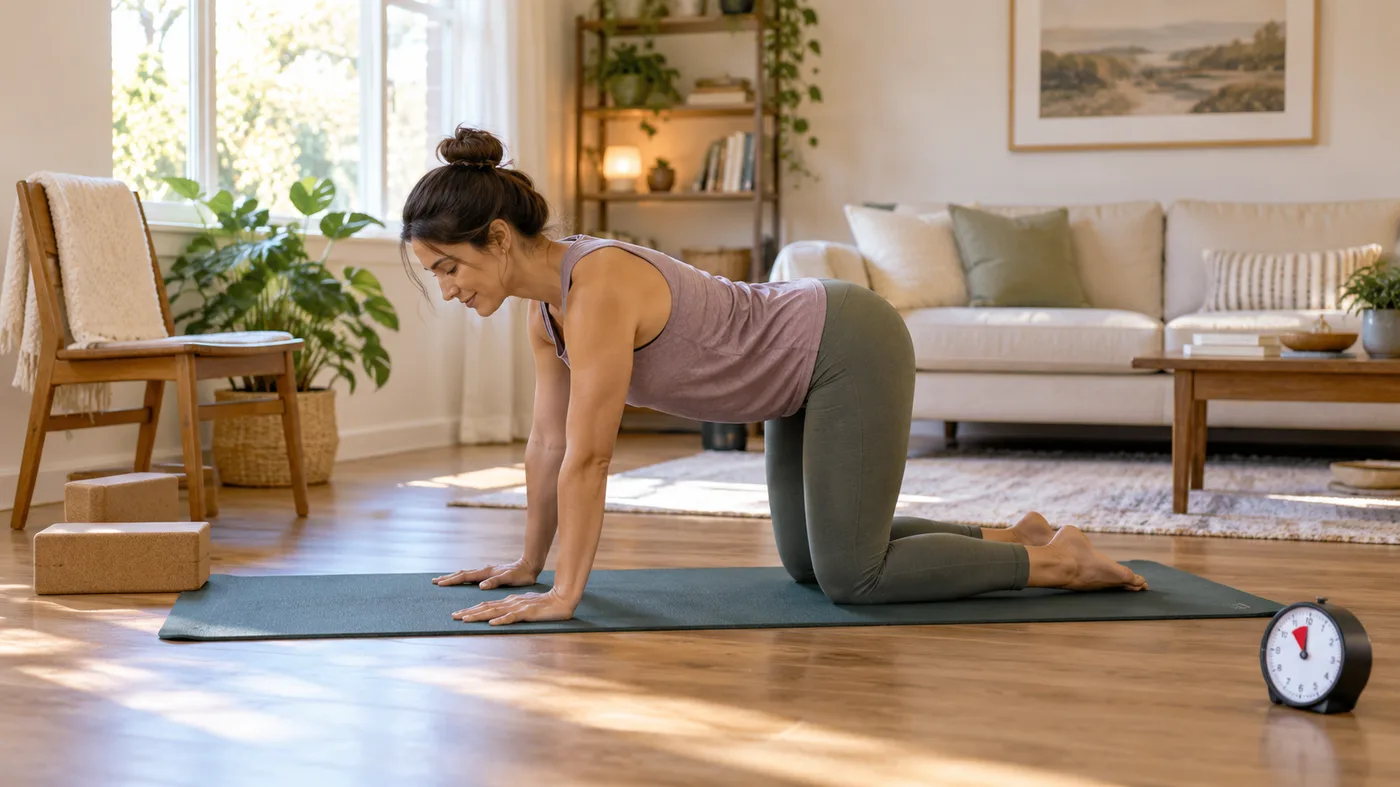
Lie down and reach arms and legs outward without touching furniture. Stand and reach overhead without hitting a light or fan. Check that doors, pets, children, heaters, and rolling chairs cannot enter the practice area unexpectedly.
Surface audit
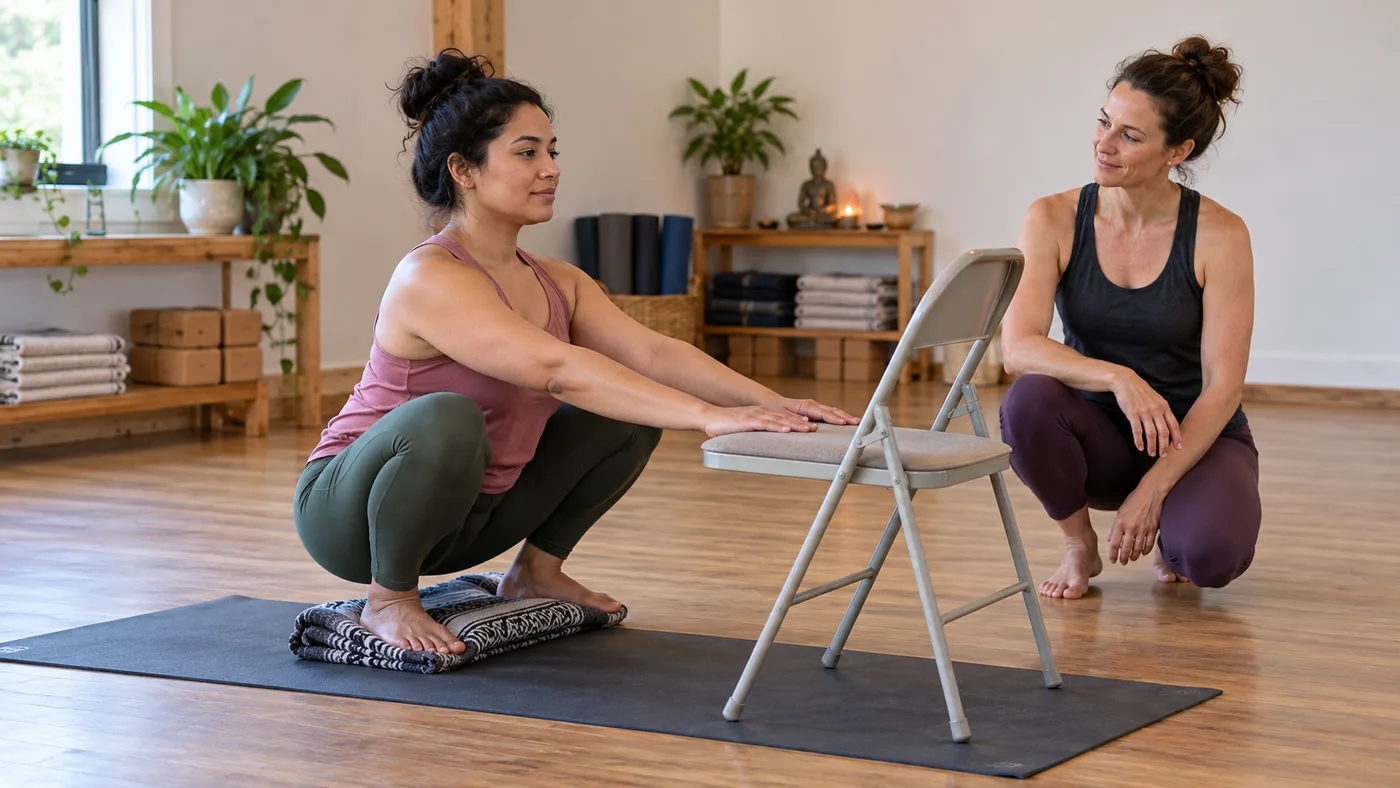
Use a stable, non-slip surface appropriate to the lesson. A yoga mat on a secure floor behaves differently from a mat on thick carpet or a loose rug. Test chairs against movement before using them as support; avoid wheeled, folding, or unstable furniture unless the instruction is specifically designed and reviewed for it.
Camera audit for live classes
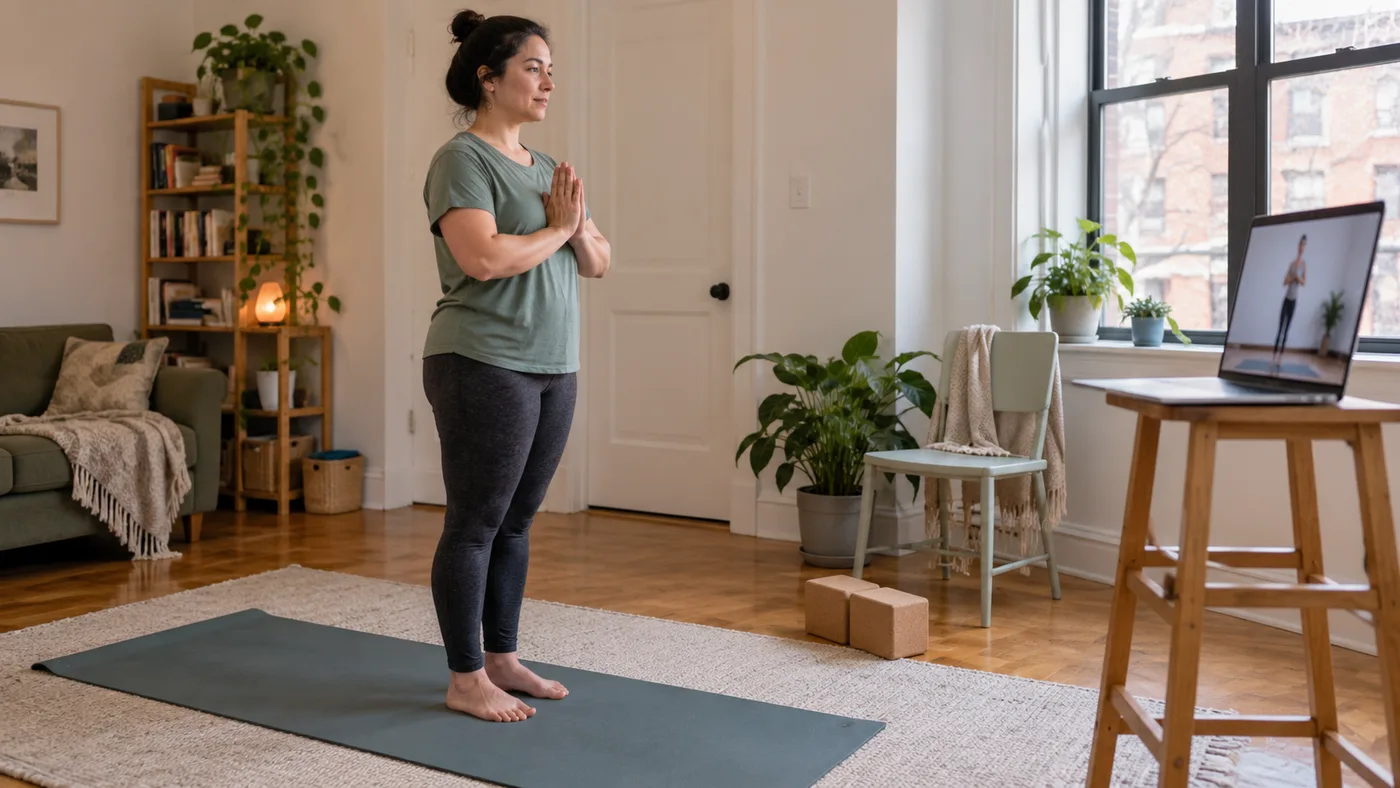
Ask how the teacher wants the camera positioned and what they can realistically observe. A single laptop view may hide the feet or lose the upper body when you lie down. Camera-off participation may protect privacy but limits visual feedback. Understand the trade-off rather than assuming the teacher can assess everything.
Privacy audit
Read how live sessions are recorded, stored, and shared. Ask whether other students can see your camera, whether chat is saved, and whether health information is collected. Do not disclose detailed medical information in a group chat simply because the platform permits it.

The 100-Point Beginner Course Scorecard
Use a sample class and the sales page to compare the categories below. The weights and thresholds are YogaLists Editorial suggestions for organizing a decision. They have not been validated as a safety test or quality assessment, and they do not provide accreditation.
A score cannot override these checks: Do not choose a course that promises cures, teaches beyond its instructor's qualifications, or lacks clear guidance on stopping and seeking help. Resolve those concerns before considering a trial or purchase, regardless of the total score.
| Category | Points | Full-credit evidence |
|---|---|---|
| Named teacher and relevant, verifiable training | 15 | Identity, training pathway, experience, and scope are clear |
| True beginner progression | 20 | Ordered curriculum, prerequisites, repetition, and next steps |
| Options and stopping guidance | 15 | Alternatives, exits, rest, prop use, and warning signs are taught |
| Scope and referral boundaries | 15 | No diagnosis or cure claims; appropriate referral language |
| Instruction quality | 10 | Clear demonstrations, usable audio, manageable pace, defined terms |
| Accessibility | 10 | Captions/transcripts, controls, readable materials, device compatibility |
| Format and feedback fit | 5 | Live/prerecorded structure matches your stated constraint |
| Transparent total cost | 5 | Trial, billing period, renewal, cancellation, and equipment cost are clear |
| Privacy and recording policy | 5 | Live-class visibility, recording, storage, and data use are explained |
If the checks above are met, these suggested bands can help compare personal fit:
80–100: consider a trial to confirm personal fit.
65–79: clarify the weaker categories before paying.
Below 65: consider other options or obtain more information.
Adjust the comparison weights to reflect your access needs and preferences. A higher total does not establish that a course is safe or suitable for you, and the non-negotiable checks still apply.
Run a Seven-Day Trial Without Chasing Completion
Day 1: Inspect
Read the curriculum, teacher biography, equipment list, cancellation terms, accessibility statement, privacy policy, and medical disclaimer. Verify credentials where possible.
Day 2: Watch five minutes without practicing
Can you follow the teacher's language? Are left and right clear? Do they show how to stop? Does the camera frame the relevant body parts?
Day 3: Complete the orientation or shortest lesson
Use the exact space, screen, audio, captions, and props you would use normally. Stop if the environment is unstable or the instruction is not appropriate.
Day 4: Repeat instead of advancing
Notice whether repetition improves understanding. A well-designed course should remain useful on a second viewing.
Day 5: Test support
Ask one specific customer-service or teacher question, such as “What lesson should a complete beginner repeat before moving on?” Evaluate the clarity and boundary of the response.
Day 6: Check the after-effect
Record confusion, discomfort, energy, and desire to continue. Do not score success by flexibility or calories.
Day 7: Decide using evidence
Complete the scorecard. Add the true monthly or course cost, including required equipment. Choose, cancel, or request clarification before the trial converts.
Price the Whole Program
As a hypothetical example, a $10-per-month library would cost $70 over seven paid months, compared with a $60 one-time course before any extra charges. These figures illustrate billing models; they are not real offers or current market prices. Compare actual charges over the same period and check how long each option gives you access. For a live series, also consider whether the available feedback meets your needs.
Calculate:
total first-cycle cost = course or subscription charge + required equipment purchases + separate platform fees + applicable taxes and other mandatory charges
Use the amounts actually payable in that billing cycle, and avoid counting fees or equipment twice. Consider auto-renewal and cancellation terms separately: note the cancellation deadline and the additional charge you would incur if the subscription renews. An uncertain cancellation risk is not a fixed amount to add to the purchase price.
Then divide by the number of sessions you are likely to complete, not the number advertised. Check whether access expires, downloads remain available, live recordings are included, refunds are permitted, and subscriptions auto-renew.
Do not interpret “unlimited” as value until you know what you will use.
Frequently Asked Questions
How long should a beginner lesson be?
Long enough to include orientation, movement, transitions, and an ending without rushing. For some people that is 15–20 minutes; others prefer 45–60. Teaching quality and fit matter more than a universal duration.
Is live online yoga safer than prerecorded yoga?
Live teaching permits questions and some observation, but camera angles, group size, teacher competence, and student disclosure still limit feedback. It is not automatically safer.
Is an RYT 200 credential enough?
An RYT 200 registration indicates completion of a 200-hour teacher-training program at a Yoga Alliance Registered Yoga School (RYS 200), with registration through Yoga Alliance. The school provides the training, not Yoga Alliance itself. Verify that the registration is current in the teacher directory. It does not establish expertise in every method or population; evaluate relevant experience, teaching quality, additional training, and scope.
Do I need to turn my camera on?
That depends on the program. Camera-on participation may improve limited visual feedback but affects privacy. Ask what is required, who can see the feed, and whether the session is recorded.
Should I choose a 30-day challenge?
Only if it includes rest, repetition, alternatives, and permission to change the schedule. A completion streak is not a substitute for progressive learning.
What if I have an injury or medical condition?
Do not ask a generic course to diagnose suitability. Discuss the situation with an appropriately licensed healthcare professional and the instructor. Confirm that the teacher has relevant competence and will refer questions outside their scope.
The Final Filter
Before buying, you should be able to answer seven questions in one sentence each:
- Who teaches the course, and what relevant training can I verify?
- What does lesson four build on from lesson three?
- How does the teacher help me reduce, stop, or rest?
- What questions will the teacher refuse or refer appropriately?
- Can I use the platform with my access needs and equipment?
- What will the entire first billing cycle cost?
- What evidence from the trial makes me want to continue?
If the marketing answers only “How inspired will I feel?”, you do not yet have enough information to purchase.
Sources
| Source | Author or organization | Published/updated | Specific information used |
|---|---|---|---|
| Scope of Practice | Yoga Alliance | Last updated February 27, 2020 | Online/group/one-to-one teaching, teaching within training and experience, accurate source disclosure, consent, and referral or refusal when advice falls outside credentials. |
| Find a Yoga Teacher / Understanding Yoga Credentials | Yoga Alliance | No page-level publication/update date shown; accessed October 21, 2026 | Public teacher directory and definitions of RYT 200, E-RYT 200, RYT 500, E-RYT 500, RCYT, and RPYT credentials. |
| Certificate Requirements for RYT Registration | Yoga Alliance | Last updated May 11, 2021; accessed October 21, 2026 | RYT applicants must show successful completion of training at a Registered Yoga School; certificates identify the school, training track, and completion date. |
| Yoga: Effectiveness and Safety | National Center for Complementary and Integrative Health, U.S. National Institutes of Health | Last updated August 2023 | Qualified instruction, risks of unsupervised learning, beginner practices to avoid, and individual discussions for pregnancy, older adults, injury, and health conditions. |