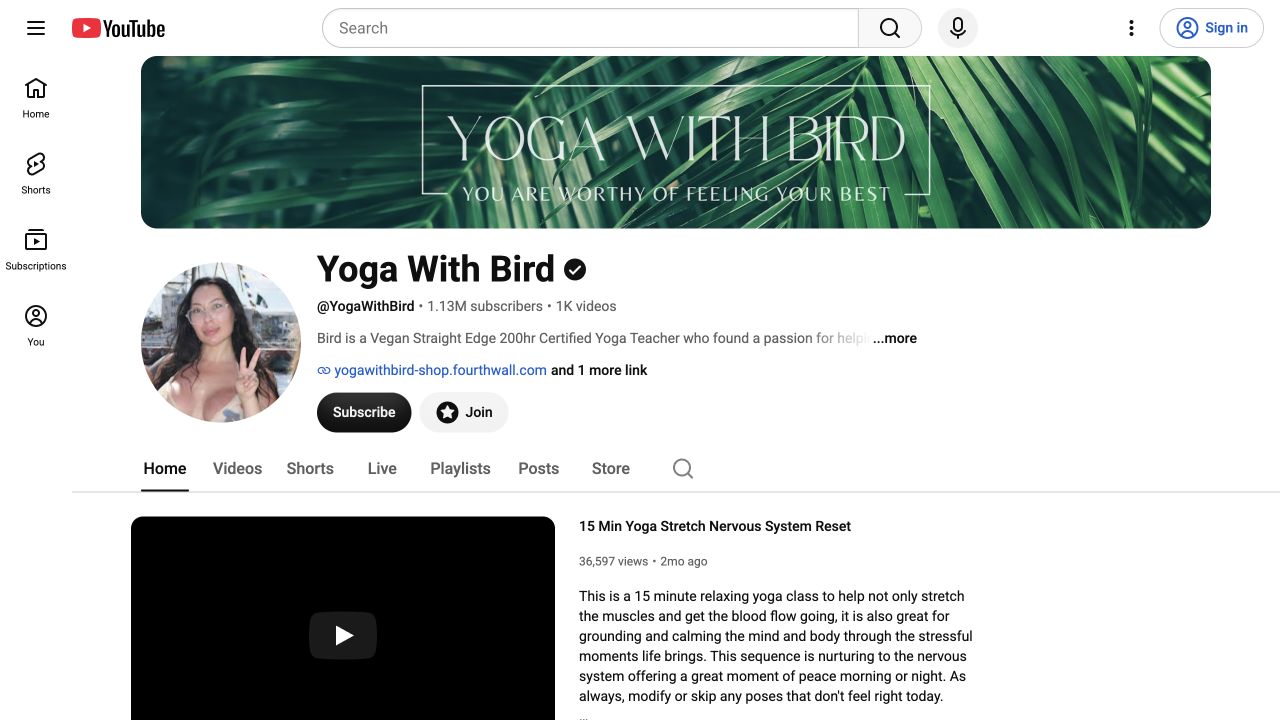
Official YouTube channel: Yoga With Bird
The most useful thing about Yoga With Bird may be its modest sense of scale. A practice can be five minutes. It can happen on the floor, beside a desk, or in a chair. It does not need to become a dramatic personal project before it earns a place in your day.
Yoga With Bird is led by Francine Cipollone, who uses the childhood nickname Bird. In a 2020 interview with Gill Haigh, she described herself as a Montreal-based, 200-hour-certified yoga teacher whose work grew from affordable private sessions into a free YouTube library. That interview remains the richest source in the available archive, so historical details in this profile are attributed to it rather than presented as a current résumé.
About this profile: This research-based profile draws on an interview and two third-party articles. It introduces the channel through those sources rather than a systematic comparison of its complete video library.
Why short classes are central to the channel's appeal
Bird told interviewer Gill Haigh that YouTube had helped her begin her own practice after a serious medical experience. She later chose the same platform as a way to offer classes without asking each viewer to pay a studio fee. Her health history is part of her personal story, not evidence that yoga treats medical conditions, and it should not be generalized into advice.
The resulting channel appears especially oriented toward people who need a low-friction entry point. A 2021 Life by Wyetha article, written by a viewer who included Bird among her three preferred YouTube teachers, highlighted practices in the five-to-thirty-minute range and described the teaching as gentle and restorative. That is one person's experience rather than a comparative test, but it helps explain why the channel can feel manageable to a beginner.
POPSUGAR also featured a five-minute Bird practice in 2020. The article described a quiet sequence of six familiar shapes, including seated side bending, a seated twist, Cat-Cow, and Child's Pose. Bird told the publication that she wanted to bring movement to an often-neglected part of the body and pair it with a moment of stillness. The article used the language of back-tension relief; readers should treat the video as general movement, not as treatment for persistent or unexplained pain.
Bird's background and teaching mix
In the 2020 interview, Bird said she had practiced for roughly seven or eight years and had taught for four. She reported completing a 200-hour training at Maui Yoga & Dance Shala and beginning her independent teaching work in 2016 after finding few local opportunities in Montreal.
She named Vinyasa, Yin/Restorative, and Power Flow among the styles in her own practice, while saying restorative yoga resonated most strongly with her. Her explanation was about balance: strength, flexibility, and restoration serve different needs. She also said the YouTube audience most often asked for beginner-friendly classes.
The interview offers an unusually concrete look at how those early videos were made. Bird said she filmed with an iPhone and two soft lights, wrote the sequence, edited the footage, recorded the voice guidance, and spent about twelve hours on a finished upload. Haigh, who had a media-production background, praised the voiceover format for feeling natural and easy to follow. That observation is more specific than a generic claim that the production is “high quality.”
Who may feel at home here
Yoga With Bird may suit readers who:
- want a short morning stretch or evening wind-down rather than a full studio-length class;
- prefer calm voice guidance and time in familiar postures;
- are beginning at home and want less visual or verbal intensity;
- enjoy restorative, Yin-influenced, or gentle mobility work; or
- need a practice that can fit into an inconsistent schedule.
You may prefer another channel if you want highly technical alignment analysis, live feedback, a systematic strength program, advanced Ashtanga study, or long discussions of philosophy. The archived evidence also does not establish how consistently the current library supplies modifications for disability, pregnancy, injury, or specific health conditions.
Build a small sampling ladder
Instead of searching for a perfect class, use three steps to learn whether Bird's pacing works for you.
Step one: five minutes. Choose a seated, morning, or gentle full-body practice. The goal is simply to learn the cadence of the voiceover and see whether you have enough time to transition safely.
Step two: fifteen to twenty minutes. Try a beginner or restorative class. Notice whether you can distinguish sensation from strain and whether the instructions offer choices when a shape does not fit your body.
Step three: a different style. If the first two sessions were quiet, sample a beginner Vinyasa or light strength flow. If you started with movement, try a restorative practice. This comparison can show whether you value Bird's range or mainly want one quiet corner of the library.
Keep the class that you would realistically repeat. Consistency is more valuable than selecting the most ambitious thumbnail.
An official starting point
For the five-minute first step, try Bird's short beginner-friendly yoga class. The creator presents it as an anytime practice. Use this small sample to judge the voice guidance and transitions before choosing a longer session.
Source: Yoga With Bird on YouTube. Official title and description checked on November 8, 2026. Duration and level, where given, are the creator's labels, not a YogaLists class assessment. YouTube may require sign-in; playback availability can vary.
Limits and safety context
Bird's own story includes anxiety, surgery, and a decision to stop medication. Those details should never be read as a recommendation to change prescribed treatment. Medication decisions belong with a qualified healthcare professional, and yoga is not a substitute for mental-health or medical care.
Similarly, a “back” or “hip” class cannot diagnose the reason something hurts. Stop a practice if you feel sharp, radiating, or worsening pain, numbness, weakness, or dizziness. Use a stable chair when a chair practice calls for one, and make sure it cannot slide. If a condition changes what movement is safe for you, seek individualized advice rather than relying on a video's broad audience label.
The evidence nevertheless supports a clear editorial conclusion: Yoga With Bird lowers the practical barrier to beginning. Its strongest use case is not proving what yoga can cure. It is giving a hesitant home practitioner a small, calm place to start.
Sources and reporting notes
- Yoga With Bird on YouTube — official channel link, verified during research.
- “10 Questions: Canadian YouTube Yoga Teacher Bird of Yoga With Bird” — 2020 first-person interview used for Bird's background, training account, teaching aims, and production process.
- “If You Suffer From Back Tension or Pain, Get Relief With This 5-Minute Yoga Flow” — 2020 third-party coverage of one short practice and a direct comment from Bird; its pain-relief framing is not repeated as a medical promise here.
- “My Top 3 Yoga Instructors on YouTube” — one viewer's 2021 experience, used only for the observed short-class range and gentle/restorative impression.