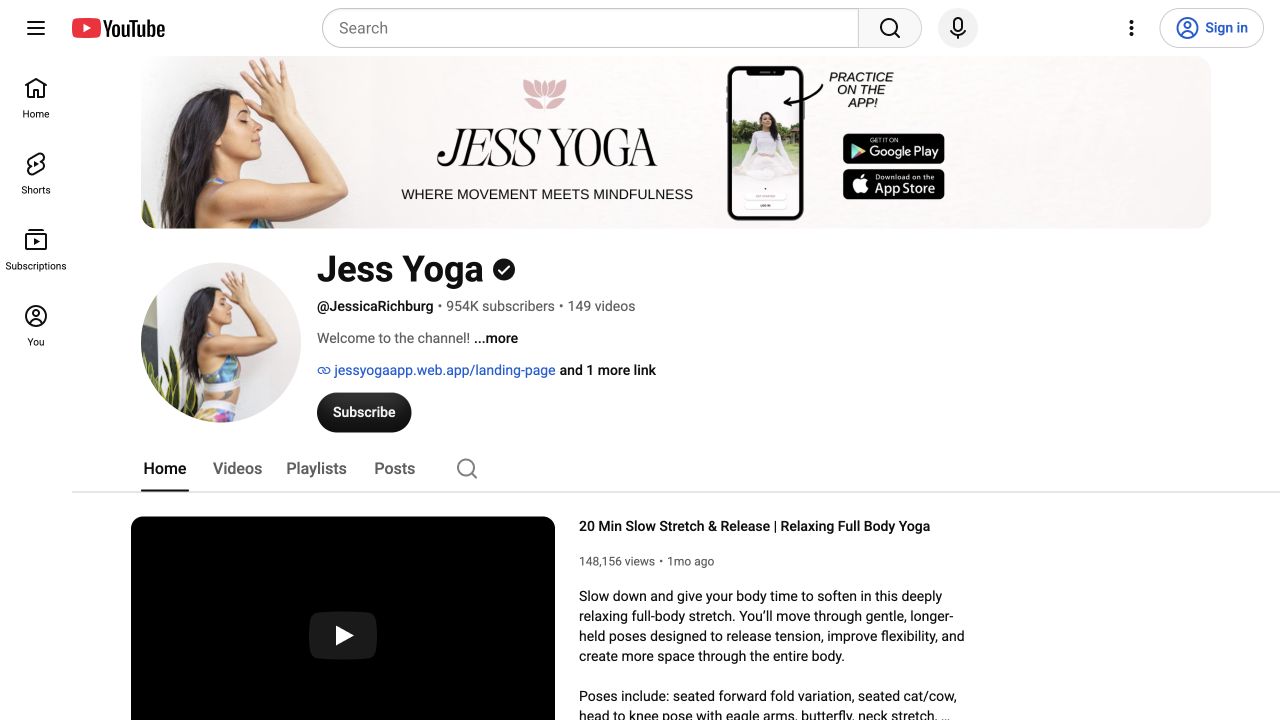
Official YouTube channel: Jess Yoga with Jessica Richburg
Jessica Richburg's public work sits between movement and reflection. Her official description is not simply “online fitness”: she identifies alignment-based Vinyasa and Yin as her main teaching styles and describes breath awareness, anatomy, and intentional sequencing as recurring parts of class.
That makes the channel worth considering if you want variety without an aggressively workout-driven tone. The official library features both active and quiet options—Vinyasa, slow flow, Yin, restorative practice, short morning and evening sessions, meditation, and beginner classes—while a separate Jess Yoga app houses paid material.
About this profile: This source-based profile draws on Jessica Richburg's official website, her official channel and one Yoga Journal recommendation. It distinguishes the free channel from the paid app, classes, courses and retreats.
Her route into teaching began at home
On her official About page, Jessica traces the start of her yoga practice to 2013. She says she first used a phone app because studio classes did not fit her time or budget while she was working in retail. A few minutes of home practice gradually became a regular routine.
That history matters because it gives her online work a plausible reader in mind: someone who may be interested in yoga but needs the practice to be available, private, and easy to begin. Jessica also writes candidly about a difficult period involving anxiety and depression, and about seeking help from a therapist before discovering yoga. That is a personal account—not evidence that yoga replaces therapy or treats a mental-health condition.
Her site says an interest in anatomy led her to complete 500 hours of massage and bodywork study in North Carolina in 2016. It lists a 200-hour yoga training in Hatha, Vinyasa, Yin, and Restorative Yoga in 2018, followed by 300 hours of continuing yoga education in Goa, India, in 2019. The latter included philosophy, asana, pranayama, meditation, kriyas, and Ayurveda. These are first-party résumé details; this profile did not independently verify certificates or current registration status.
Jessica says she began sharing progress photographs and videos online, then published free classes and eventually moved into full-time yoga teaching. Her official site now connects the free channel with courses, retreats, private work, and a subscription app.
What her stated teaching style suggests
Three ideas recur in Jessica's own description.
Alignment-based Vinyasa. This suggests moving sequences with attention to how poses are organized, rather than movement for speed alone. It does not mean every cue will suit every skeleton, injury history, or level of experience.
Yin and slower practice. Her free-class listings include Yin, restorative, bedtime, seated, and slow-flow options. Readers who do not want every session to be a strong flow have several possible entry points.
Mindful themes and breath. Jessica says she uses purposeful sequencing and encourages exploration of both physical and subtler experience. That language points toward a reflective style. Readers who prefer entirely secular, anatomy-only instruction may want to preview a few openings and closings before committing to a longer class.
An independent Yoga Journal roundup provides one concrete example of the more active side of her work. It selected a 17-minute Vinyasa practice for leg strength and noted that the sequence included Warrior III and Revolved Chair. That small mention cannot establish the quality of the entire channel, but it confirms that her catalog is not limited to relaxation-focused classes.
Choose your first class by purpose, not popularity
Jessica's official site presents a broad free selection. A simple decision path is more useful than choosing whatever the algorithm serves first.
If you are new or returning
Start with a 15- to 35-minute beginner or gentle full-body class. Give yourself permission to pause between transitions. The useful test is whether the instructions help you understand where to place your attention—not whether you can reproduce the deepest version on screen.
If you want flowing movement
Choose a 20- to 30-minute Vinyasa class before attempting a longer power flow. Notice how much weight the sequence places on wrists and shoulders, how quickly it moves through standing poses, and whether rest options are stated clearly.
If you need a quieter session
Try a slow flow, restorative class, or short Yin practice. In Yin, “longer” is not automatically better. Use props, reduce the depth of a shape, and come out when sensation becomes sharp, electrical, numb, or joint-centered.
If meditation interests you
Sample a short body scan or basic guided practice before a longer meditation. Meditation can be supportive for many people, but it can also feel unsettling. People with an existing mental-health condition should follow the advice of their care team rather than treating a creator's recording as individualized therapy.
An official starting point
Easy Yoga For Beginners | Gentle Flow - 15 Minutes
For a concrete first sample, try Jessica's 15-minute gentle beginner flow on her public Jess Yoga channel. It offers a short full-body starting point for the new-or-returning route above. Pause between transitions and use it to assess the pace and clarity of her cues.
Source: Jess Yoga (@JessicaRichburg) on YouTube. Official title and description checked on November 8, 2026. Duration and level, where given, are the creator's labels, not a YogaLists class assessment. YouTube may require sign-in; playback availability can vary.
Who may enjoy Jessica Richburg—and who may not
Jessica may appeal to people who want:
- a visually calm home-practice environment;
- both Vinyasa and Yin rather than one fixed pace;
- classes organized around time of day or a general movement focus;
- a teacher who connects breath and intention to physical sequencing; or
- a free way to assess the teaching before considering an app or course.
Another teacher may be a better fit if you need live corrections, rehabilitation for pain or injury, prenatal specialization, highly traditional Ashtanga instruction, or a progressive strength plan with measured benchmarks. Although some public class titles may say “all levels,” that label cannot account for your individual health history.
Free channel versus paid app
Jessica's official app page describes the app as an ad-free environment with longer classes, courses and challenges, search filters, offline downloads, meditations, and community features. Those are the creator's own product claims, and the available archive does not include an independent app test.
Use the free channel to answer the questions that marketing copy cannot: Do you like the pacing? Can you act on the cues without staring at the screen? Are alternatives offered when a pose is not available? Does the mix of physical and reflective language suit you?
A measured conclusion
The published evidence makes the strongest case for readers who want both flowing and quiet practices in one calm-looking library. It does not justify a verdict on the whole channel or paid app. A fair trial is one gentle or beginner class, one Vinyasa practice, and one Yin or restorative session, followed by an honest decision about which format fits your week.
Practice with at least three different class types before paying. If they all work for you and you specifically need organization, downloads, or a larger library, the app may solve a real problem. If you are happy repeating a handful of public classes, there is no need to upgrade simply because more content exists.
Safety and evidence limits
This profile found credible first-party detail about Jessica's education and intentions, but very little independent reporting on her channel. The Yoga Journal mention covers one video, not the library. Testimonials on a creator's own site can describe individual satisfaction but cannot establish typical results.
Online yoga is general instruction. It cannot evaluate pain, dizziness, pregnancy, recent surgery, joint instability, or a neurological condition. Stop when symptoms are sharp, radiating, worsening, or unusual, and seek appropriately qualified advice when you need an individualized plan.
Sources and reporting notes
- Jessica Richburg on YouTube — official channel link, verified through Jessica's official website.
- Jessica Richburg: About and yoga journey — first-party account of her background, training, teaching styles, and move into online teaching.
- Jess Yoga official website — used to identify the range of free class formats and the relationship between the channel, courses, and app.
- Jess Yoga app — official product page used only to identify the app's stated formats and features; the product was not independently tested.
- “These 5 Yoga Practices Will Tone & Strengthen Your Legs” — independent 2022 roundup containing one short description of Jessica's 17-minute Vinyasa practice.