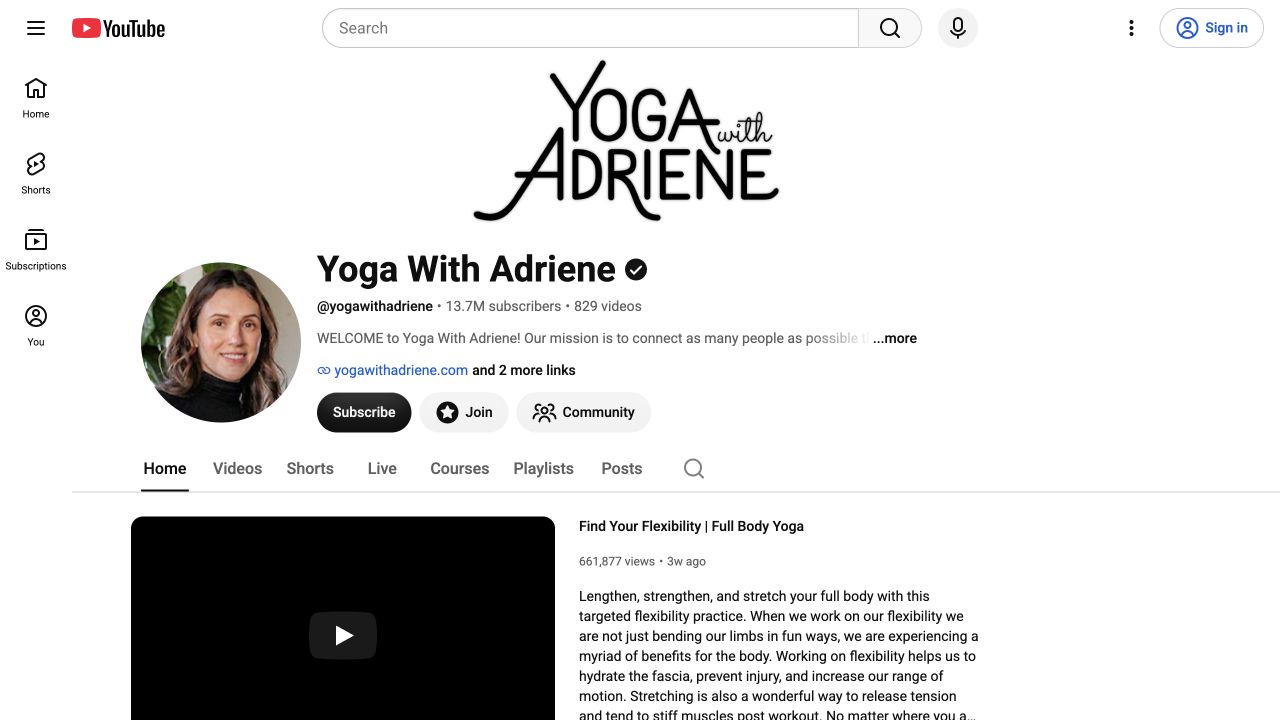
Official channel: Watch Yoga With Adriene on YouTube
Yoga With Adriene is often recommended to people who want to practice at home without making yoga feel like another performance test. Adriene Mishler teaches from Austin, Texas, and the channel's public identity is deliberately approachable: ordinary clothes, conversational cues, humor, and repeated permission to adapt the practice. That tone is not incidental. In a 2020 interview with Austin public radio station KUT, Mishler described trying to meet viewers as a friend rather than positioning herself as an all-knowing expert.
The result is a large free library that can serve several different needs: a first encounter with yoga, a short movement break, a themed practice, or a structured month-long routine. Its size is also the channel's main navigation problem. A newcomer who opens the video tab and scrolls at random can easily spend more time choosing than moving. This guide explains the clearest entry points and the limits of what can be concluded from published sources.
About this profile: This source-based profile draws on official pages, interviews and published reporting. It introduces the free channel and the separately paid Find What Feels Good library; the two are distinct offerings.
The idea behind the channel
Mishler and business partner Chris Sharpe began publishing Yoga With Adriene videos in 2012. The public project has remained centered on free yoga and mindfulness, while the separate Find What Feels Good membership offers a paid library. The official About page describes Mishler's method as a mixture of traditional yoga and breath practices with developmental movement, storytelling, mindfulness, and other influences. Those are the creator's own descriptions, not independent evaluations of a formal method.
What independent reporting does support is the importance of her delivery. Yoga Journal's profile of Mishler highlights several choices that translate unusually well to a screen: cueing without seeing the student, offering invitations rather than orders, and letting personality remain visible. The same profile also reports the less polished side of running a huge channel, including burnout and a move away from weekly uploads in 2020. This is useful context for readers who otherwise see only an apparently effortless catalog.
Her manner is inclusive in a practical, rather than technical, sense. She frequently presents practice as something to explore rather than complete perfectly. A MEL Magazine feature about male viewers found that this low-pressure atmosphere helped some people who did not identify with conventional studio yoga imagery. That article covers a particular audience, so it should not be treated as evidence that the channel works for everyone.
Four sensible ways into the library
The official FAQ does a better job of organizing the catalog than YouTube's general feed. It points beginners toward an official beginner playlist and the Foundations of Yoga series, and it groups practices by themes such as seated, standing, hands-free, gentle, core, and total-body yoga. It also explains the channel's recurring monthly calendars and annual 30 Days of Yoga projects.
1. Learn one building block at a time
If yoga vocabulary is new, start with the beginner or Foundations material rather than an energetic full-body flow. A pose-focused lesson gives you time to understand where hands, knees, and feet are intended to go. That does not replace live feedback, but it reduces the number of unfamiliar instructions arriving at once.
2. Choose by constraint
“What can I comfortably do today?” is often a more useful search than “What is the most popular video?” The official collections make it possible to look for seated or hands-free options when bearing weight through the wrists is undesirable, or for gentle and shorter practices when energy is limited. A label is only a starting point: preview the opening minute and any listed props before committing.
3. Use a calendar when choice becomes friction
Monthly calendars and 30-day journeys remove the daily decision. They can help someone who enjoys a sequence and a visible sense of continuity. They are not a contract. Resting, repeating a day, or abandoning a challenge that does not suit you is a reasonable response, not a failed program.
4. Search for a specific time and purpose
The library includes practices framed around morning, bedtime, focus, movement breaks, and different body regions. Treat those phrases as navigation aids, not treatment claims. A video titled for the back, stress, or another concern cannot diagnose the cause of discomfort or guarantee a health outcome.
Who is most likely to appreciate it?
Yoga With Adriene may be a good starting place if you:
- want free, full-length guidance before deciding whether to pay for an app or studio;
- respond well to warm, conversational instruction and occasional humor;
- prefer frequent reminders that a pose can be adjusted;
- need both very short options and longer, structured series; or
- feel more comfortable practicing privately while learning the basic language of yoga.
You may prefer a different teacher if you want a tightly athletic pace with minimal conversation, highly technical alignment analysis, a single specialized lineage, or real-time correction. An experienced student may also find some beginner-oriented explanations slower than desired. The channel's friendliness does not give Mishler visual access to your form; a livestream recording and a live teacher are not equivalent.
A three-practice sampling plan
There is no need to begin with a 30-day commitment. A more informative trial uses three different contexts over a week:
- Start with a short beginner or Foundations practice. Notice whether the cueing gives you enough time to move and whether you understand the transitions without repeatedly looking at the screen.
- Try one gentle or hands-free session. This shows how the teacher handles a quieter pace and modifications, rather than judging the channel from a single general flow.
- Try one standard total-body practice at a comfortable length. Afterwards, note energy, joint comfort, and whether the conversational style helped you stay engaged.
Keep the variables simple. Use a stable surface, have a folded blanket or sturdy support nearby, and stop if you feel sharp pain, dizziness, numbness, or unusual shortness of breath. If you are managing an injury, pregnancy, a medical condition, or a return to activity after surgery, seek individual advice from an appropriately qualified professional. A general YouTube class cannot assess those circumstances.
Accessibility and practical details
The official site maintains a page for closed captions and transcripts and says captions are manually reviewed. That is a meaningful feature for people who practice with low audio, process written instructions more easily, or need caption support. Availability can still vary by video, so confirm it on the particular class you plan to use.
The free/paid distinction also deserves clarity. The YouTube catalog is substantial and can be used without joining Find What Feels Good. The membership is a separate product with additional organization and content. This profile did not test the membership, compare its current catalog with YouTube, or assess value for money.
Finally, “yoga for all” is a mission statement, not proof that every practice is accessible to every body. Screen-based instruction has unavoidable blind spots. Watch the introduction, use the pause button, and choose another class when the starting positions or pace do not match your needs.
Bottom line
The strongest reason to sample Yoga With Adriene is not fame or catalog size. It is the combination of free access, multiple low-commitment entry points, and a teaching voice designed to lower the emotional barrier to beginning. The channel is especially useful when you navigate by your present constraint—time, energy, experience, or position—rather than treating the most-viewed practice as a universal prescription.
Sources and reporting notes
- Yoga With Adriene on YouTube — official channel destination, checked on the research date.
- Yoga With Adriene official website — used for the project's free-yoga mission and the distinction between the public channel and wider brand.
- Yoga With Adriene: About Us — creator-provided biography and description of the teaching approach.
- Yoga With Adriene FAQ — official navigation guidance for beginner, Foundations, themed playlists, calendars, and 30-day series.
- Yoga With Adriene: Yoga for Beginners playlist — official YouTube playlist linked as a direct starting point for newcomers.
- Closed Captions and Transcripts — official accessibility information.
- KUT interview with Adriene Mishler — direct interview used for her description of the viewer relationship.
- Yoga Journal: “8 Lessons Adriene Mishler Has Learned” — independent profile used for online teaching choices and publishing context.
- MEL Magazine: “How Adriene Mishler Became Yoga's Guy Whisperer” — third-party reporting on one segment of the channel's audience.