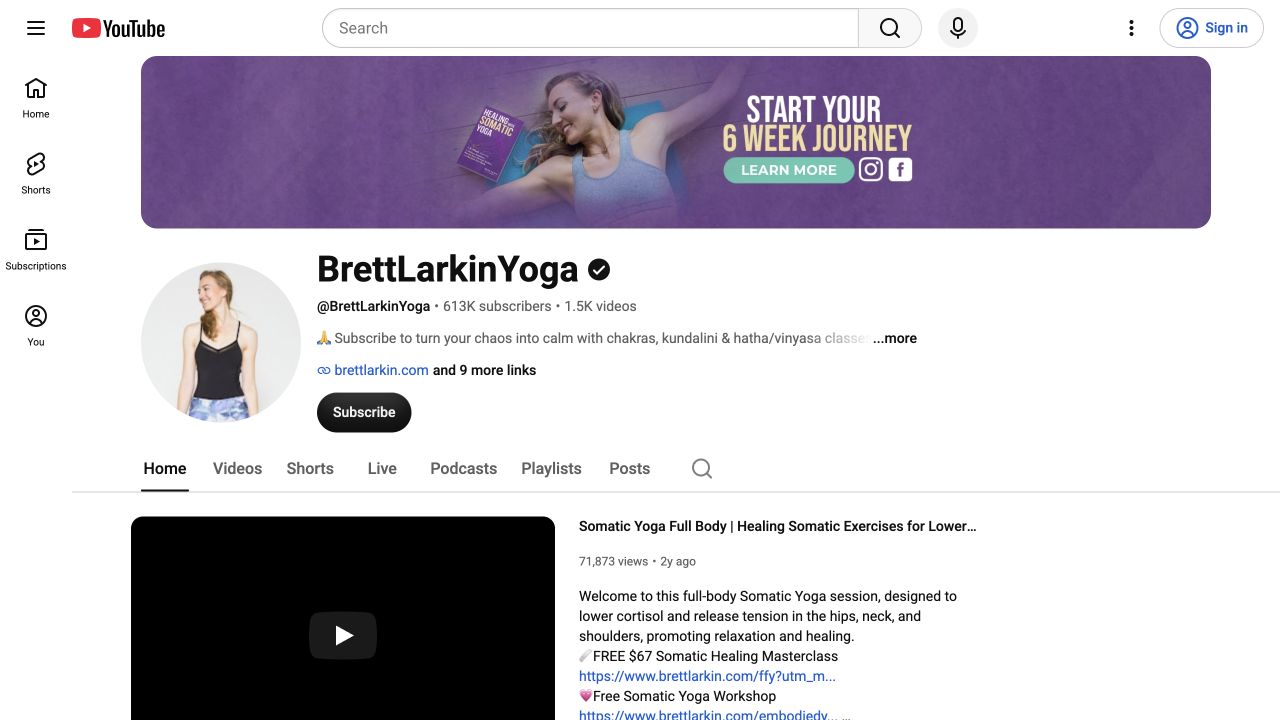
Official YouTube channel: BrettLarkinYoga
Brett Larkin's YouTube channel is one entrance to a much larger education business. Free classes and tutorials sit alongside the Uplifted Yoga podcast, books, memberships, specialty courses, and 200-hour and 300-hour teacher-training paths.
That breadth can be useful, but it changes the way a reader should evaluate the channel. A pleasant free class does not by itself validate a certification program. A polished training page does not prove that its schedule, feedback, or cost fits your life. The sensible approach is to separate the free teaching, the educational philosophy, and the paid offer—and assess each on its own evidence.
About this profile: This source-based profile draws on Brett's official pages, independent expert quotations, podcast show notes and one first-person course review. Membership and Uplifted training descriptions are attributed to those sources, not presented as independent accreditation.
First, understand the two layers
The public teaching layer
Brett's official site describes her YouTube material as free classes, tutorials, and guided practices across physical and reflective topics.
The public channel is where a prospective student can evaluate concrete qualities: pace, cueing, use of Sanskrit, amount of explanation, and the balance among movement, breath, and reflection.
The professional-education layer
Brett is the founder of Uplifted Yoga. Her current official biography describes her as an E-RYT 500, RPYT, certified somatic coach, author, and online teacher educator. It says her current teaching emphasizes somatic yoga, trauma-conscious and consent-based practice, Kundalini-informed work, and nervous-system education. These are the creator's credential and positioning claims; this profile did not independently inspect each certificate, scope of practice, or accrediting record.
It is particularly important not to translate “nervous-system-informed” into medical treatment. A yoga teacher may offer body-awareness tools without diagnosing trauma, treating anxiety, or replacing mental-health care.
What the available evidence says about her teaching
One of the strongest independent windows is a 2026 Yoga Journal article about mirroring—the skill of moving on the opposite side while facing students. Brett is quoted throughout as one of several experienced teachers. Her advice is practical: build the skill through repetition, use a bracelet or other physical marker to remember sides, change position in the room when that helps students see, and prioritize what allows the student to understand and stay safe.
That evidence is narrow, but it is more meaningful than generic praise. It shows attention to how information reaches a student, not merely how a teacher performs a pose.
An official Brett Larkin article makes a similar distinction between an “instructor” who demonstrates from the front and a “teacher” who observes and gives individualized feedback. The terminology is her framework, not an industry rule, but it reveals the standard she says she values.
Her entrepreneurial teaching also emphasizes community. In 2022 Yogahealer podcast notes, Brett is quoted encouraging creators to begin with a small audience, listen to what people ask for, and build with that community rather than trying to invent everything alone. The page is a show-notes summary rather than a full transcript, so those comments are useful for understanding her business philosophy, not for verifying revenue or reach.
How to sample Brett's free work
Use three different formats so that one class does not carry the whole decision.
- A foundational class or pose tutorial. Choose something within your current ability. Ask whether setup, transitions, and alternatives are explained before the hardest version appears.
- A guided practice. Try a moderate class long enough to reveal the overall arc: arrival, warm-up, main work, and closing. Notice whether the pace allows you to listen to your body.
- A non-asana resource. Sample a meditation, podcast conversation, or philosophy-oriented lesson. This shows whether the broader Uplifted vocabulary and worldview feel useful to you.
Do not evaluate a teacher-training purchase while you are still deciding whether you like the basic teaching. Repeat at least one free class. Repetition often reveals more about cue clarity than novelty does.
What to verify before enrolling in Uplifted training
The official 200-hour training page presents a substantial curriculum: anatomy, philosophy, teaching methodology, business education, assessment, and routes involving self-paced study or group support. It also contains testimonials and accreditation claims.
However, the archived page reviewed for this profile appears to combine new and older page sections. Some passages describe live classes and mentorship as available options; older FAQ material describes required live attendance and a four-month cohort. One area calls a printed manual optional, while another says students must budget for a manual and books. Lifetime access language appears beside an older completion window. These conflicts may result from hidden or legacy website content, but a buyer cannot safely guess which terms govern enrollment.
Before paying, obtain written answers to these questions:
- Which live sessions are required for the exact track you are buying?
- How long do you have to finish, and what access remains afterward?
- What feedback is individual, and who provides it?
- What books, manuals, insurance, registration, and assessment fees are additional?
- What credential do you receive from Uplifted, and what separate steps or fees apply for Yoga Alliance registration?
- What are the refund, transfer, and deferral rules attached to your checkout?
Save the syllabus and terms that apply on the date of purchase. Course pages can change; your decision should rely on the actual agreement, not an old review.
One first-person review—and what it can and cannot prove
A 2025 Yogi Times article offers unusually specific evidence about Uplifted's Pregnant and Powerful: Teacher's Edition. The writer says she completed the training and includes course screenshots, a completion certificate, and an outdoor practice image. She describes prerecorded lessons, PDFs, asana labs, a final quiz, app/browser access, and no live teaching component. Her stated drawbacks include content overlap, limited peer interaction, and no live practice or feedback.
That is more useful than an anonymous endorsement, but it still has limits. The article contains affiliate links, represents one learner, and reports pricing and continuing-education terms that can change. It also cannot establish that graduates are clinically qualified to manage pregnancy complications. The review itself distinguishes the short continuing-education certificate from the much more extensive requirements associated with the RPYT designation—an important distinction for buyers to verify directly with Yoga Alliance.
Who may appreciate Brett Larkin's ecosystem?
The free channel may suit someone who wants an established teacher with material that extends from basic practice into meditation, philosophy, and teacher education. Uplifted may interest already-committed students who specifically want an online professional curriculum and are willing to compare the written requirements carefully.
Another option may be better if you:
- want a channel devoted mainly to quiet follow-along classes with little discussion;
- need live, in-person correction as your primary learning format;
- prefer a single yoga lineage rather than a blend that includes Vinyasa, somatic, prenatal, and Kundalini-informed material;
- are seeking medical, psychological, or pregnancy care rather than yoga education; or
- do not want business coaching or creator-economy material mixed into teacher development.
Safety, trust, and the bottom line
Brett's official biography uses language about trauma, stored stress, nervous-system regulation, and healing. These ideas require careful boundaries. Credentials in yoga, somatic coaching, or massage do not automatically make someone a physician, psychotherapist, physical therapist, or prenatal clinician. Readers with pain, pregnancy complications, trauma symptoms, or a diagnosed condition should use appropriately licensed care and ask what falls within a yoga educator's scope.
The best-supported conclusion is not that Brett's program is “the best,” nor that every viewer needs a certification. It is that she has built an unusually broad bridge from free online teaching to professional education. Use the free side to test the teaching. Use primary documents and direct questions to assess the paid side. Keep inspiration separate from verification.
Sources and reporting notes
- BrettLarkinYoga on YouTube — official channel link, verified during research.
- About Brett Larkin and Uplifted Yoga — official first-party biography and current teaching/credential claims; those claims were not independently verified here.
- Uplifted Yoga Podcast — official podcast page, added as a direct navigation link for readers who want to sample Brett's non-asana teaching.
- “What Is the Difference Between Yoga Instructor and Yoga Teacher?” — official article used to understand Brett's stated teaching framework.
- Uplifted 200-hour online yoga teacher training — official sales page reviewed for curriculum and purchasing questions; contradictory legacy/current passages are disclosed above rather than resolved by assumption.
- Uplifted 300-hour online yoga teacher training — official program page linked so readers can inspect the advanced track separately; it was not independently tested.
- “Best Online Prenatal Yoga Teacher Training Review” — 2025 first-person affiliate review with screenshots and a certificate; used for one learner's documented experience and stated drawbacks, not as proof of typical outcomes.
- “Successful Women in Yoga and Ayurveda with Brett Larkin, Katie Silcox and Cate Stillman” — 2022 podcast show notes and selected direct quotations about community and entrepreneurship.
- “Yoga Teachers, Here's How to Improve Your Mirroring Skills” — 2026 independent article quoting Brett alongside other teachers on practical mirroring technique.