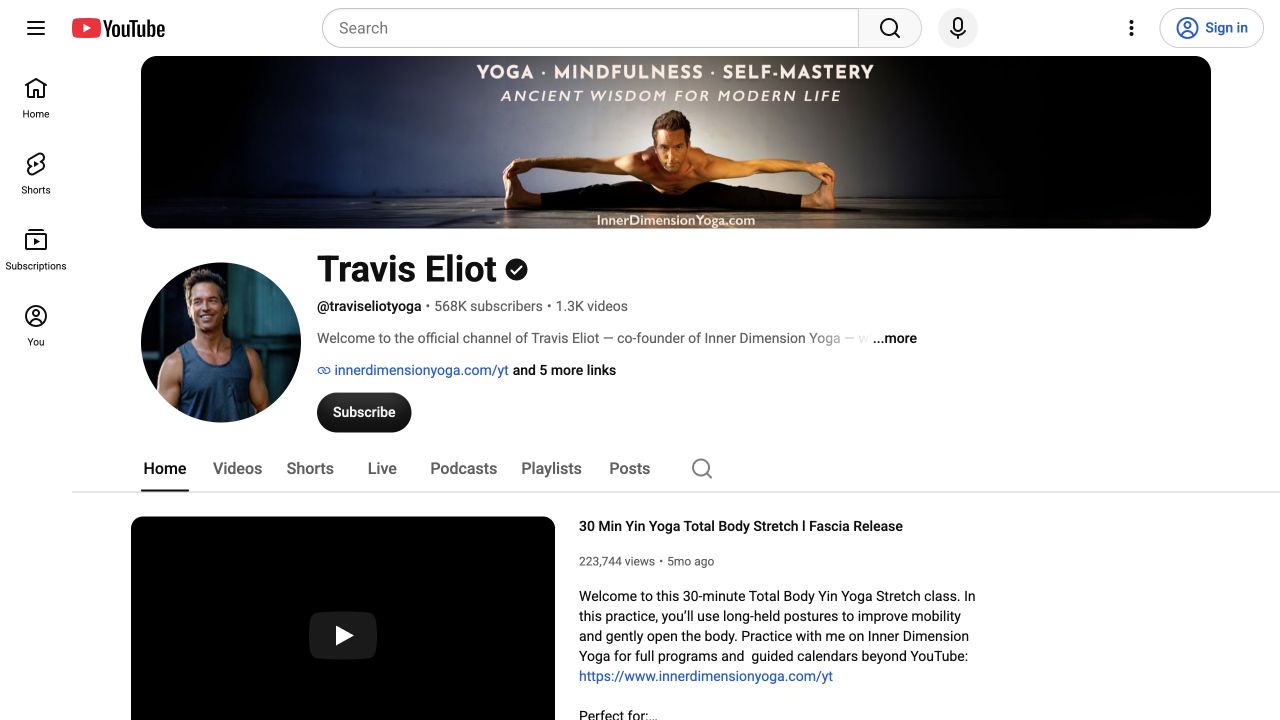
Travis Eliot's work sits at an unusual intersection: physically demanding power yoga, long-held yin practices, meditation, and polished long-form programs. That range is the main reason to consider his channel—and the main reason not to choose a class by thumbnail alone. A vigorous flow and a quiet yin session can ask very different things of the same body.
Official YouTube: Travis Eliot on YouTube
The practical short version is this: Eliot may appeal to readers who want yoga to feel structured, purposeful, and shaped like a complete class rather than a quick movement clip. His teaching is associated with rhythmic vinyasa, sustained effort, philosophical framing, and a second, slower lane of yin and restorative work. Viewers who prefer minimal talking, strictly secular fitness cues, or very short mobility breaks may find a more stripped-down channel easier to use.
The route from performance to teaching
Eliot's public origin story is unusually dramatic, so it needs careful attribution. In a 2017 Gaiam interview, he said his mother introduced him to meditation recordings when he was nine. He later pursued acting and film, moved to Los Angeles, and took his first yoga class at 26 after a coworker had encouraged him to try it.
Both that interview and Eliot's official site describe two experiences that he regards as turning points: a near-drowning during a retreat on Kauai and surviving the 2004 Indian Ocean tsunami while in Thailand. These are personal recollections, not independently reconstructed events in this profile. What matters for understanding his work is the meaning he gives them: he presents them as the point at which yoga changed from an interest into a vocation.
A long Creative Influencer podcast transcript adds useful texture. Eliot connects his acting background to the cadence of his instructions, his comfort with storytelling, and his awareness of how a class unfolds for an audience. He also acknowledges that his first attempt at teaching in Thailand was improvised and poorly sequenced. That admission is more informative than a polished biography: his public method appears to have been developed through years of teaching and media production, not through instant mastery.
What distinguishes the practice
The clearest distinction is the power-yin pairing.
On the active side, Eliot's official program overview describes power yoga and his broader "Holistic Yoga Flow" approach. These practices can include repeated transitions, strength-demanding holds, and longer class arcs. His programs have included The Ultimate Yogi, Yoga 30 for 30, PY108, and collaborations with Lauren Eckstrom. Program names and availability change, so they are better treated as examples of his long-form approach than as a current shopping list.
On the quieter side, Eliot has produced yin classes and the multiweek Flexibility & Beyond program. A 2023 Siddhi Yoga review describes clear verbal cues, prop options, stories, and philosophical reflections across a live class, a shorter video, and that program. The review is useful as one person's documented experience, although the publisher also sells yoga training and should not be treated as a neutral testing lab.
A more independent, narrower data point comes from a 2025 Yoga Journal roundup. Its writer tried a 30-minute full-body yin practice and noted the calm music, reassuring language, neck and shoulder work, and the need to modify one shape with a pillow under the knees. That does not prove how the whole channel teaches, but it illustrates an important feature: Eliot's slower classes may still contain shapes that require individual adjustment.
Meditation and "daily wisdom" also appear alongside physical practice on the official channel. The language can include yoga philosophy, Taoist ideas, personal growth, or spiritual reflection. Some readers will experience that as welcome context. Others may prefer a teacher who keeps philosophy and exercise in separate videos.
Who is likely to appreciate Travis Eliot's channel?
The available evidence points to a good fit for viewers who:
- enjoy a deliberate, performance-aware teaching voice rather than sparse cueing;
- want both strong vinyasa and slower yin in one creator's library;
- like classes with themes, stories, meditation, or reflective language;
- are interested in progressing through a series rather than collecting unrelated workouts; or
- already understand basic poses and can make sensible modifications.
Consider another starting point if you need chair-based practice, highly clinical rehabilitation, silence between cues, or close individual correction. A video cannot see whether a long yin hold is compressing a joint or whether fatigue is changing your alignment in a power sequence.
A low-commitment way to sample the channel
Do not begin with the longest challenge simply because it promises the most complete experience. A three-class sample gives better information.
- Try one shorter beginner, gentle, or foundational class. Pay attention to whether Eliot's pacing and amount of talking help you orient yourself.
- On a different day, try a short yin practice with a blanket, blocks, or firm pillows nearby. Treat suggested hold times as options, not obligations.
- Only then sample a power flow at an appropriate level. Notice whether you can follow the transitions without repeatedly looking away from your mat.
Afterward, ask concrete questions: Could you hear the setup before the movement began? Were modifications offered before you needed them? Did the philosophical material add focus or pull you out of the practice? Those answers are more useful than deciding whether the class felt impressive.
An official starting point
20 Min Gentle Yoga Flow | Stretch & Relax
Start the gentler route above with Travis's 20-minute stretch-and-relax flow. The official description calls this a slow, gentle practice; it does not give a beginner level. Use the sample to judge his pacing before choosing a longer yin or power class, and reduce or skip any movement that does not suit you.
Source: Travis Eliot (@traviseliotyoga) on YouTube. Official title and description checked on November 8, 2026. Duration and level, where given, are the creator's labels, not a YogaLists class assessment. YouTube may require sign-in; playback availability can vary.
Evidence and safety limits
Eliot's guest articles and promotional pages sometimes use broad wellness language about detoxification, stress, the nervous system, or disease. This profile does not adopt those claims. Yoga can be meaningful movement and contemplative practice without being presented as treatment for cancer, addiction, anxiety, injury, or other medical conditions.
Long passive holds are not automatically safe because a class is labeled yin, and a polished power flow is not automatically suitable for beginners. Stop for sharp pain, numbness, dizziness, loss of control, or symptoms that concern you. If you are pregnant, injured, managing a health condition, or returning after surgery, seek guidance appropriate to your situation rather than relying on a general video description.
Eliot also operates beyond YouTube through Inner Dimension and other programs. This article does not compare their value, test their current catalog, or evaluate teacher-training outcomes.
About this profile: This research-based profile draws on interviews, official pages and a small number of documented class impressions. It introduces the free YouTube library separately from paid programs.
Sources and reporting notes
- Travis Eliot program overview — first-party overview used to describe the current power-yoga and Holistic Yoga Flow positioning; program availability can change.
- Travis Eliot official site — current public positioning and examples of programs; promotional claims were not treated as independent evidence.
- Travis Eliot: Inner Dimension TV — first-party overview of the paid platform; linked for reader navigation, not used as independent evidence of outcomes.
- Travis Eliot official YouTube channel — verified channel destination and stated content categories.
- Gaiam: “Meet Travis Eliot” — 2017 first-person career and practice history.
- Pfeiffer Law: “Travis Eliot: Influencing Inner Peace” — long podcast transcript used for teaching and production background.
- Siddhi Yoga review of Travis Eliot's yin yoga — one reviewer's experience across several formats; commercial context noted above.
- Yoga Journal: satisfying yin yoga sequences on YouTube — limited first-person impression of one 30-minute practice.