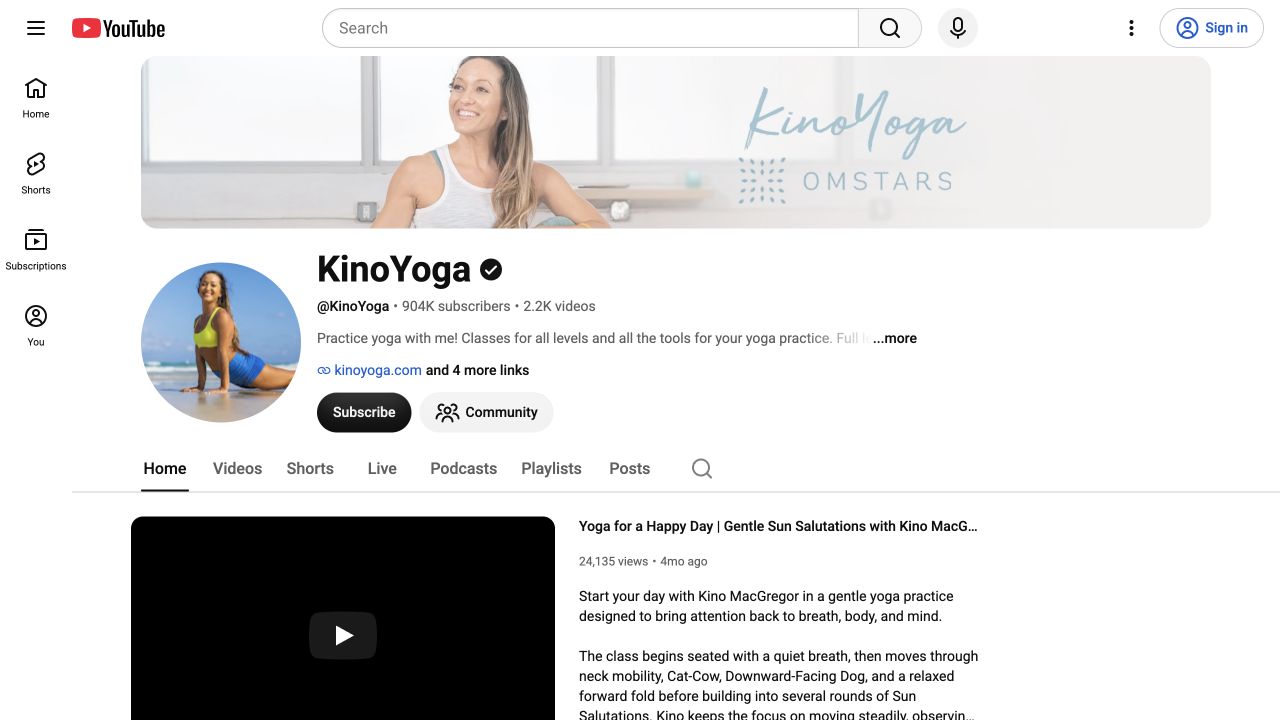
Official YouTube channel: KinoYoga
Kino MacGregor's work is difficult to reduce to “follow-along yoga.” Her public teaching combines a demanding Ashtanga practice, detailed pose instruction, meditation, spiritual reflection, books, podcasting, and the Omstars online platform. A viewer may encounter a basic drill, a long discussion of practice, or a progression toward a technically advanced inversion.
That range is the channel's opportunity and its main caution. Kino can give a curious student far more context than a workout-only creator. She can also make highly developed physical practice look deceptively close. Beginners need to choose carefully rather than assuming every popular tutorial is a suitable starting point.
About this profile: This research-based profile draws on biographical sources, Kino's own writing, podcast notes and Yoga Journal articles. Credentials and program descriptions are attributed to their sources; the free channel and Omstars are distinct offerings.
The foundation is Ashtanga
An Ashtanga.com biography says Kino tried yoga at nineteen without a movement-training background. Three years later, she joined Mysore-style classes in New York, then traveled to Mysore, India, to study with K. Pattabhi Jois. The biography says that after seven years of repeated study trips, Jois certified her to teach when she was twenty-nine.
That account appears across several older profiles, including a 2014 episode page from The One You Feed. The podcast notes add useful themes from the conversation: depression and searching, the difficulty of yoga, surrendering to a method, finding a genuine teacher, and balancing ambition with non-attachment. The episode page provides a topic summary rather than a full interview transcript, so it supports this outline of themes, not a detailed reconstruction of the conversation.
Kino and her husband, Tim Feldmann, co-founded Miami Life Center. She later created Omstars, an online yoga platform. Her official website now foregrounds workshops, a yoga podcast, classes, books, and an accessibility-oriented presentation of Ashtanga. Product counts, follower totals, and business claims differ across old and current pages, so this profile avoids treating them as stable facts.
What distinguishes the teaching
Technique is connected to a larger practice
Kino's Yoga Journal sequences rarely present a physical goal as an isolated trick. A 2015 forearm-balance progression links the slow work of building shoulder and core strength with patience and self-acceptance. A 2016 handstand plan opens with her statement that the pose took five years of practice, then progresses through plank work, core exercises, wall preparation, and a supported attempt.
That does not make the tutorials automatically safe for a beginner. It does show a consistent teaching idea: skill is built through repetition and preparation, not a single breakthrough cue.
Breath and philosophy are not decoration
A 2014 “deep presence” sequence centers the breath and includes seated practice, supported heart opening, constructive rest, and headstand preparation. Her official writing treats yoga as an ethical and spiritual discipline rather than a route to a photogenic pose.
Readers should know that the language can be explicitly spiritual. Some will find that meaningful; others may prefer a teacher who keeps instruction anatomical and secular. Neither preference is a measure of seriousness.
Community is part of her story
In a 2017 excerpt from The Yogi Assignment, Kino describes leaving a drug-fueled party life, entering a regular Ashtanga routine, and relying on a community of practitioners during the transition. The excerpt is valuable because it shows why she emphasizes sangha, discipline, and practice beyond the mat. It is a personal narrative, not a clinical account of treating depression or substance use.
Accessibility is a developing theme
Kino is often associated with advanced Ashtanga postures. Her current official homepage, however, promotes Accessible Ashtanga, which reframes the method for varied bodies, abilities, and experience levels while attempting to retain its traditional structure. That tension—advanced personal practice alongside a wider invitation—is important to understanding her current public position.
The available sources do not establish how consistently every older video meets that newer accessibility goal. A reader should evaluate the actual class in front of them rather than applying the label to the whole archive.
Three useful doors into KinoYoga
1. Begin with explanation, not spectacle
Look for foundational Ashtanga material, breath instruction, or a basic drill. Learn the vocabulary and pace before choosing a class built around handstand, headstand, deep backbending, or leg-behind-head work.
2. Sample the reflective side
Try a podcast episode, short talk, or meditation-oriented practice. This will tell you whether Kino's philosophical and spiritual framing adds value for you. It also prevents the channel from being judged only by its most visually dramatic thumbnails.
3. Treat advanced tutorials as progressions
If you already have a stable practice, choose a tutorial whose prerequisites you can meet. Repeat the preparatory stage over several sessions. Do not advance merely because the next step appears in the same video.
A fair sample can combine a foundational session and a reflective resource. Add an advanced tutorial only if you already meet its prerequisites; one inversion video or spiritual talk cannot represent the whole channel.
An official starting point
What is Ashtanga Vinyasa Yoga? with Kino MacGregor
Use Kino's introduction to Ashtanga Vinyasa as the first stop for the explanation route above. This is a public introductory talk, so use it to get oriented before selecting a physical practice; it is not a guided beginner workout or an inversion tutorial.
Source: KinoYoga (@KinoYoga) on YouTube. Official title and description checked on November 8, 2026. Duration and level, where given, are the creator's labels, not a YogaLists class assessment. YouTube may require sign-in; playback availability can vary.
Who may benefit from this channel?
KinoYoga may suit people who:
- want to understand Ashtanga as a method rather than collect random poses;
- enjoy precise physical challenges and patient skill-building;
- value meditation, ethics, and spiritual inquiry alongside asana;
- are interested in the relationship between tradition and online access; or
- want material that can remain relevant as their practice develops.
Someone may prefer a different starting point if they want only gentle beginner flows, minimal Sanskrit or spirituality, live corrective feedback, or exercise designed around a current injury. Readers seeking a short relaxation class may also find a creator with a narrower restorative focus easier to navigate.
Safety: advanced instruction needs context
The Yoga Journal sequences cited here include headstand, forearm balance, handstand, and deep backbending. Written cues and pose photographs cannot provide the individualized screening a teacher would use in person.
Do not use an advanced tutorial to self-clear for inversions. Your experience, load tolerance, balance, injury history, and health can change what is appropriate. Work with a qualified teacher when you are learning how to bear weight upside down, and ask a clinician when a health condition is relevant. Stop when you feel unwell, experience pain, or lose control.
Older articles also make broad claims about healing, circulation, or stress. This profile does not repeat those as medical facts. Yoga may be meaningful and challenging without being described as treatment.
Reporting limits worth keeping visible
Much of Kino's biography comes from industry profiles and her own accounts. Current official pages and older bios disagree on book totals, series level, project descriptions, and audience figures. This profile does not rely on those changing totals or present them as verified current facts.
This profile also does not attempt to resolve broader debates about Ashtanga lineage, authority, hands-on adjustments, or institutional history. A complete critical biography would need reporting beyond the current archive, including independent voices and historical context.
Within those limits, the evidence supports a useful conclusion: KinoYoga is best approached as a long-term teaching archive, not a single workout feed. Its value lies in the connection among method, disciplined practice, and inner inquiry—provided the reader chooses material that matches their actual experience.
Sources and reporting notes
- KinoYoga on YouTube — official channel link, verified during research.
- Kino MacGregor official website — used for current public positioning, projects, podcast, and the Accessible Ashtanga description. Marketing claims were not treated as independent evidence.
- Omstars — official platform homepage, used to help readers distinguish Kino's subscription platform from her public YouTube channel; the service was not tested.
- Miami Life Center: Ashtanga teachers — official studio page identifying Kino MacGregor and Tim Feldmann as founders.
- Kino MacGregor personal biography — historical account of her entry into Ashtanga, Mysore study, certification, and early publications; the archived source uses HTTP rather than HTTPS.
- The One You Feed, Episode 033: Kino MacGregor — 2014 podcast page used for its interview-topic summary, not as a transcript.
- “Kino MacGregor's 4-Step Get-Your-Handstand Plan” — first-person history and technical progression.
- “Kino MacGregor's Sequence for Inner Strength” — forearm-balance progression and discussion of patient practice.
- “Kino MacGregor's Yoga Practice for Deep Presence” — breath, presence, and sequence evidence; medical-style claims were not adopted.
- “How Sangha Drew Kino MacGregor Away from the ‘Spiritual Desperation’ of a Drug-Fueled Party Scene” — 2017 book excerpt used as a clearly attributed personal narrative.