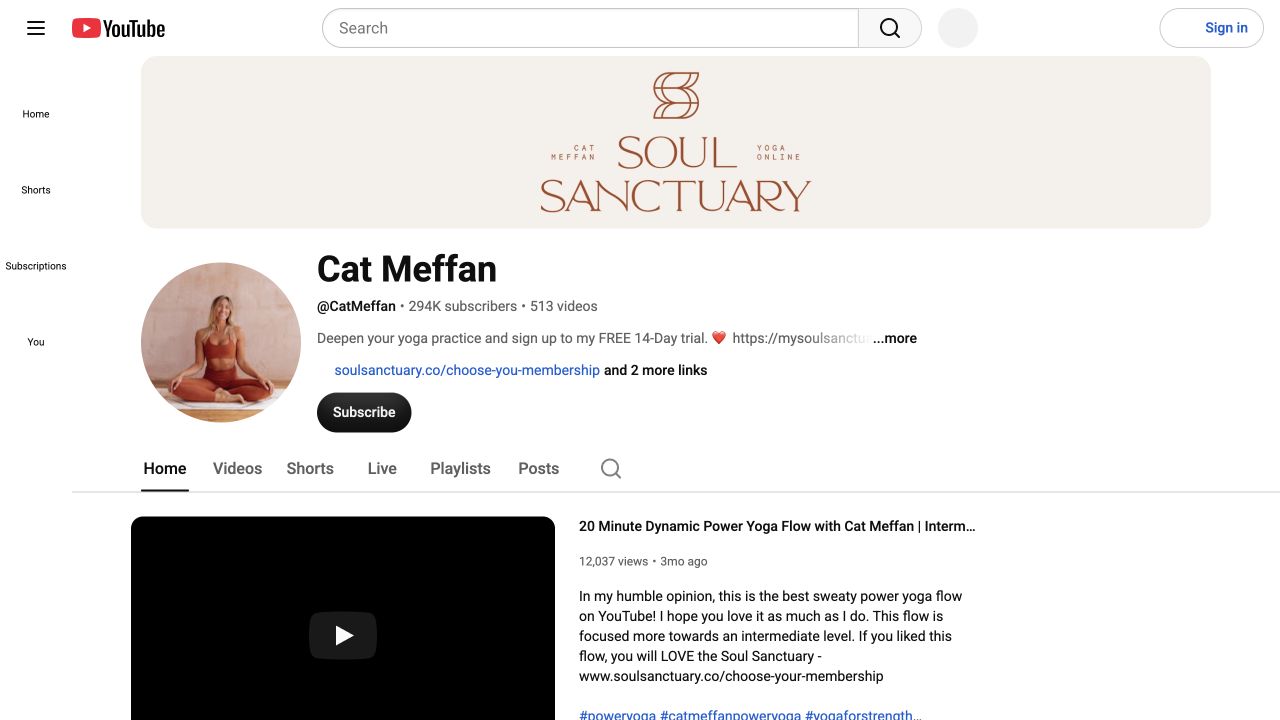
Cat Meffan's public work has changed shape more than once. Early profiles presented her as a gymnast, dancer, jewelry designer, fitness blogger, and yoga teacher. Her current platform, Soul Sanctuary, uses a more expansive vocabulary: embodied movement, vinyasa, meditation, breathwork, sound, retreats, and community. The through-line is not one fixed yoga method. It is movement used as a route into a broader experience of wellbeing.
Official YouTube: Cat Meffan on YouTube
That breadth can be attractive, but it helps to know what you are choosing. A skills class, a Rocket sequence, a yin practice, and a breathwork session are not interchangeable simply because they appear under one brand.
Three phases of an online teaching identity
1. Imperfect Matter and the multi-sport years
A 2015 Get the Gloss interview described Meffan as a jewelry designer, yoga teacher, fitness blogger, and general wellness enthusiast. She spoke about growing up with gymnastics and ballet, enjoying short intense workouts, planning exercise into the week, and treating wellbeing as a lifestyle rather than a quick plan.
By 2016, her blog Imperfect Matter was receiving industry attention. In a Vuelio interview, Meffan called it a wellbeing hub and emphasized that she did not want to cover yoga alone. Food, travel, different forms of training, and the less polished parts of her own fitness journey were part of the proposition. She also discussed the practical machinery of a creator business: analytics, public relations, social promotion, and producing different images for different platforms.
Those profiles are old, but useful. They show that the current brand did not emerge from a narrow lineage-based channel. It grew from a creator already comfortable crossing between yoga, fitness, travel, and lifestyle.
2. Retreats as a teaching laboratory
An article on Meffan's own site, “How to Get the Most Out of a Wellness Retreat”, appears to date from her first retreat period around 2017. Its practical details reveal her priorities: attending alone can be welcome, shared spaces can be phone-free, journaling can help guests notice how they feel, and rest matters as much as scheduled activity.
Meffan also wrote that she entered yoga from the physical asana side and did not expect it to become a process of self-exploration. That shift helps explain why retreats became more than destination fitness in her later marketing. It also marks a boundary: a retreat can provide time, instruction, and community, but broad language about transformation or healing should not be confused with psychotherapy or medical care.
3. Soul Sanctuary
The current Soul Sanctuary site presents a membership with yoga and movement classes, meditation, a community component, live sessions, and retreat access. Styles named across the official pages include Vinyasa, Mandala, Yin, Rocket, Power, and embodied flow, with guest teachers contributing philosophy, strength, arm balances, Pilates, qigong, and restorative work.
The retreat page describes Meffan as having 1,300 hours of qualifications across movement, meditation, sound, breathwork, and related areas. That is a first-party total; the page does not itemize every provider and certificate, and this profile has not independently audited them. The same caution applies to testimonials and phrases such as "deep healing." They communicate the experience the company wants to create, not a guaranteed outcome.
What may feel distinctive in class
The available material suggests an expressive rather than purely technical teaching identity. Meffan's background in dance and gymnastics fits the fluidity implied by Mandala, Vinyasa, and embodied movement. Her retreat writing places equal emphasis on social connection, reflection, and willingness to try something unfamiliar. Soul Sanctuary adds meditation and philosophy rather than treating the mat as a standalone workout surface.
That combination may work well for a viewer who wants classes to feel emotionally and aesthetically engaged. It may be less appealing to someone who wants sparse anatomical instruction, one fixed tradition, or exercise without spiritual or self-development language.
There is also a meaningful range of intensity. Rocket, Power, inversions, and arm-balance drills can demand substantial strength, load tolerance, and familiarity. Yin and meditation may be slower, but slower does not mean universally safe or easy. Long holds can still irritate joints or nerves when a shape is poorly matched to the person.
Who may appreciate Cat Meffan's work?
Consider sampling the channel if you:
- enjoy fluid sequences informed by dance as well as yoga;
- want vigorous options and reflective practices in the same ecosystem;
- value journaling, meditation, community, or retreat culture;
- already know basic poses and want to explore Mandala, Rocket, or inversion skills; or
- respond well to an encouraging, emotionally expressive teaching voice.
Look elsewhere, or add specialist support, if you need rehabilitation, a strictly secular fitness session, close correction for advanced skills, or clinical mental-health care. Readers who prefer a single predictable class format may also find a multi-teacher wellness platform unnecessarily broad.
How to sample without overcommitting
Begin on Cat Meffan's free YouTube channel before interpreting the paid platform or a retreat as the next step.
Use one familiar movement class as your baseline. Choose a short Vinyasa or gentle flow at a stated level. You are assessing the instruction, not proving your flexibility.
Then test the contrast. Try one slower session—yin, meditation, or restorative movement—and notice whether the language and pacing feel supportive. On another day, experienced practitioners can sample a more athletic class below their maximum level.
Treat skills as skills. If a video includes headstand, handstand, deep backbends, or arm balances, look for prerequisites, exit strategies, and wall or prop options. Watching once before participating is sensible.
Evaluate the platform separately from the teacher. If you later consider Soul Sanctuary, check the current library, cancellation terms, teacher mix, and whether the classes you actually want are included. A compelling retreat aesthetic does not answer those product questions.
An official starting point
YOGA FOR COMPLETE BEGINNERS | 30-Minute Yoga | CAT MEFFAN
For the baseline session above, open Cat's 30-minute class for complete beginners on her public YouTube channel. Its explicit starting-level label gives you a concrete way to sample her instruction before exploring the wider library. Use this ordinary beginner sample separately from decisions about specialist pregnancy or breathwork content.
Source: Cat Meffan (@CatMeffan) on YouTube. Official title and description checked on November 8, 2026. Duration and level, where given, are the creator's labels, not a YogaLists class assessment. YouTube may require sign-in; playback availability can vary.
Pregnancy and other safety-sensitive content
A 2025 Yahoo Health/Tom's Guide article quotes Meffan discussing hip work, lateral movement, glute strength, and spinal waves during pregnancy. The writer tried the movements and linked research on prenatal yoga, but one article is not a substitute for individualized prenatal assessment. The source does not set out a specialist prenatal credential for Meffan.
Pregnant viewers should follow advice from an appropriate clinician and a suitably qualified prenatal teacher, particularly when symptoms or medical circumstances affect activity. The same principle applies to breathwork and health conditions: intensity and breathing patterns should be chosen for the person, not for the promise in a title.
About this profile: This source-based profile introduces Cat Meffan's channel and the separately offered Soul Sanctuary membership and retreats. Testimonials describe their contributors' experiences, not established outcomes.
Sources and reporting notes
- Cat Meffan official YouTube channel — official channel linked by Cat's own site.
- Cat Meffan official site — current route to free classes and Soul Sanctuary.
- Soul Sanctuary — current first-party description of class styles, membership, teachers, and community features.
- Vuelio: “Blogger Spotlight: Cat Meffan, Imperfect Matter” — 2016 interview used for early brand and creator-business context.
- Get the Gloss: “How I Keep Fit: Cat Meffan” — 2015 interview used for early movement background and philosophy.
- Cat Meffan: “How to Get the Most Out of a Wellness Retreat” — first-party retreat priorities and personal account of her evolving relationship with yoga.
- Yahoo Health/Tom's Guide prenatal movement article — limited pregnancy-specific reporting, used with the safety caveats above.